 blog
blog
5 Ways to Improve Infection Control in Clinics
Table of Contents
- Why Infection Control in Clinics Matters More Than Ever
- 1. Strengthen Hand Hygiene and Respiratory Hygiene Practices
- 2. Master PPE Donning and Doffing to Reduce Pathogen Transmission
- 3. Build Disinfection Protocols for Medical Offices That Actually Get Followed
- 4. Use Medical Facility Cleaning Checklists to Standardize Environmental Hygiene
- 5. Meet OSHA Bloodborne Pathogens Standard Compliance Without the Guesswork
- The Angles Most Clinics Miss: Monitoring, Mindset, and Supply Resilience
- Frequently Asked Questions
Last Updated: September 20, 2026
Why Infection Control in Clinics Matters More Than Ever
Infection control is the set of practices a clinic uses to stop the spread of germs between patients and staff. It covers hand washing, protective gear, cleaning, and safe handling of needles. Get it right, and you prevent healthcare-associated infections before they start.
1. Strengthen Hand Hygiene and Respiratory Hygiene Practices
Hand hygiene is still the single most effective way to block pathogen transmission in a clinic. Yet compliance often drops when staff get busy. The World Health Organization outlines five moments when hand washing matters most, including before touching a patient and after contact with surfaces near them.
Make it easy to comply:
- Place alcohol-based sanitizer at every exam room door
- Stock gloves and sinks within arm's reach, not down the hall
- Post simple signs on respiratory hygiene and cough etiquette
- Offer masks and tissues at check-in for anyone with symptoms
Making Hand Hygiene Compliance Stick
Compliance improves when it is visible. Track it, and share the results with your team.
2. Master PPE Donning and Doffing to Reduce Pathogen Transmission
Most staff know how to put on protective gear. Far fewer remove it correctly. Doffing is where contamination happens, because gloves and gowns carry germs from the patient to the wearer's skin and clothing. But doffing technique is only half the job. The other half is choosing the right PPE for the task and keeping enough of it on hand so staff never have to improvise.
Match the PPE to the Task, Not the Habit
A common pattern in clinics is that everyone grabs the same gear regardless of what they are doing. That wastes supplies and gives a false sense of protection. Use the task to drive the choice:
- Gloves for any contact with blood, body fluids, mucous membranes, or non-intact skin. Change them between patients and never wash and reuse them.
- Gowns or aprons when a procedure or patient care activity is likely to splash or spray. A gown worn for one patient should not be worn into the next room.
- Masks and eye protection for any activity that could generate splashes, sprays, or droplets, including suctioning, wound irrigation, and some dental work.
- Respirators (fit-tested N95 or equivalent) for aerosol-generating procedures and for care of patients with suspected airborne infections.
Train the sequence, not just the equipment:
- Remove gloves first, peeling them inside out
- Take off the gown without touching the outer front
- Wash hands immediately after removing any item
- Save the mask or respirator for last
Extended Use and Reuse: Know the Limits Before You Need Them
During a supply shortage, clinics face pressure to stretch PPE. That is a decision that should be made in advance, not in the middle of a surge. The CDC has published contingency and crisis capacity strategies that describe when extended use or limited reuse may be considered. The key points for a clinic manager:
- Extended use means wearing the same respirator for multiple patient encounters without removing it. It is only appropriate when supplies are running low and the respirator has not been soiled or damaged.
- Reuse means storing a respirator between uses. It carries higher contamination risk and should be a last resort.
- Never reuse gloves, gowns, or face shields. These are single-use items.
- Any extended-use or reuse decision should be documented, communicated to staff, and reversed as soon as normal supply returns.
Build a PPE Buffer Before the Next Shortage
- Set a minimum stock level for each item based on two weeks of normal use, plus a buffer for a surge.
- Assign one person to check stock weekly and reorder when the level drops below the par.
- Rotate stock so older items are used first, and check expiration dates on respirators and sanitizer.
- Identify a secondary supplier now, before your primary runs dry. A backup account takes minutes to open and can save days later.
Where it falls short: training fades fast without repetition. A quick drill at a staff meeting keeps the sequence fresh, and a quarterly supply audit keeps the buffer honest.
3. Build Disinfection Protocols for Medical Offices That Actually Get Followed
Disinfection protocols for medical offices fail for one reason: they are too complicated to follow on a busy day. The best protocol is short, clear, and tied to a schedule.
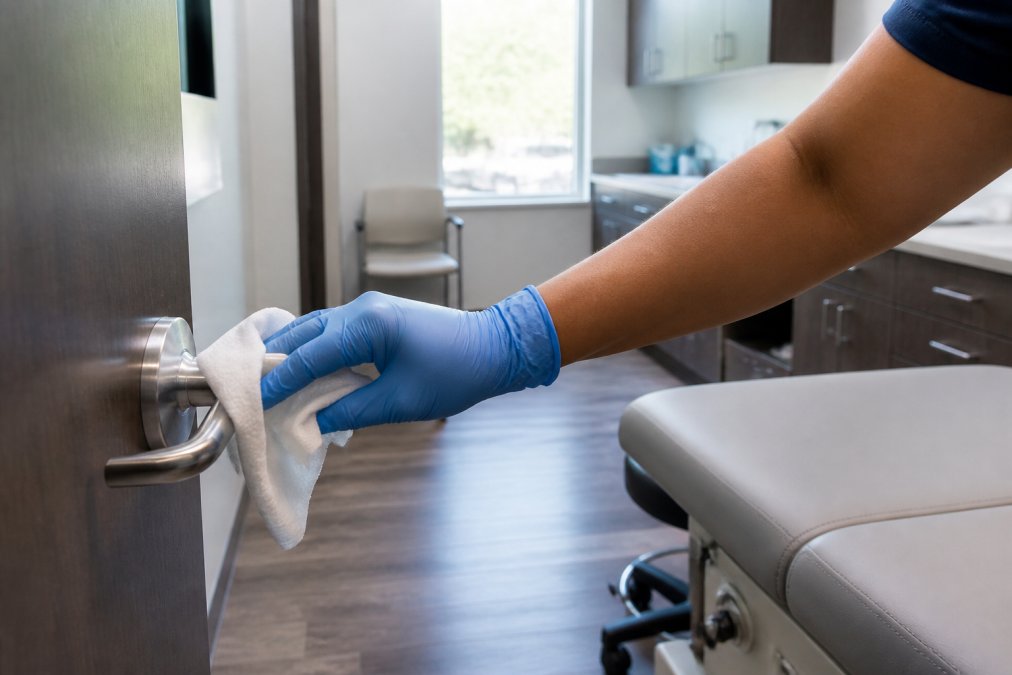
High-Touch Surfaces and Surface Decontamination
Clean high-touch points at least twice a day, and between patients where possible. Surface decontamination should always follow the product's contact time. If the label says the surface must stay wet for one minute, wiping it dry in five seconds does nothing.
Prioritize:
- Door handles and light switches
- Exam tables and armrests
- Keyboards, phones, and check-in counters
- Blood pressure cuffs and stethoscopes
4. Use Medical Facility Cleaning Checklists to Standardize Environmental Hygiene
Medical facility cleaning checklists turn good intentions into repeatable results. They remove guesswork and make sure nothing gets missed when a room is turned over in a hurry.
| Task | Frequency | Who Owns It |
|---|---|---|
| Hand sanitizer refill | Every shift | Front desk |
| High-touch surface wipe-down | Twice daily | Clinical staff |
| Exam room turnover | Between patients | Clinical staff |
| Floor and restroom cleaning | Daily | Cleaning vendor |
| Sharps container check | Every shift | Clinical staff |
5. Meet OSHA Bloodborne Pathogens Standard Compliance Without the Guesswork
OSHA bloodborne pathogens standard compliance is not optional for any clinic where staff may contact blood or body fluids. It requires a written exposure control plan, training, and safe sharps handling. The standard is detailed, and inspectors look for evidence that the plan is actually in use, not just filed away.
The OSHA Bloodborne Pathogens standard spells out what employers must provide. At minimum, your clinic needs:
- A written exposure control plan, reviewed and updated each year
- Free hepatitis B vaccination offered to at-risk staff
- Annual training on bloodborne pathogens
- Proper sharps containers and PPE at the point of use
What Belongs in the Exposure Control Plan
A plan that sits in a binder and never changes is a red flag. The plan should be a working document that reflects how your clinic actually operates. It should include:
- A list of job classifications and tasks where exposure to blood or body fluids is possible
- The methods your clinic uses to control exposure, including engineering controls (sharps containers, self-sheathing needles), work practice controls (no recapping), and PPE
- The procedure for evaluating the circumstances of an exposure incident
- The post-exposure evaluation and follow-up process, including who provides it and how it is documented
- The hepatitis B vaccination program, including how it is offered and how declinations are recorded
- The training program, including who conducts it and how attendance is tracked
- The sharps injury log, which is required for employers who must maintain a log of needlestick and sharps injuries
Sharps Safety and Needle-Stick Prevention
Most needle-stick injuries happen during disposal, not during treatment. Staff get rushed and try to recap a needle by hand. Ban recapping. Place sharps containers within reach, and replace them before they are full.
A few specifics that make a difference:
- Choose sharps containers that are closable, puncture-resistant, and labeled with the biohazard symbol.
- Replace containers when they are three-quarters full, not when they are overflowing.
- Never force a sharp into a full container or reach into one to retrieve an item.
- Use self-sheathing or retractable needles where they are available and appropriate.
When an Exposure Happens
If an injury happens, act fast. Wash the site with soap and water, report it immediately, and seek medical evaluation the same day. The evaluation should include:
- Documentation of the exposure, including the route and the source patient's status if known
- Testing of the source patient, with consent, for bloodborne pathogens
- Post-exposure prophylaxis when indicated, started as soon as possible
- Follow-up testing and counseling for the exposed worker
- A confidential medical record kept separate from the personnel file
Compliance comes down to three habits: keep the exposure control plan current, ban recapping, and treat every needlestick as a same-day medical event. Do those, and the paperwork takes care of itself.
The Angles Most Clinics Miss: Monitoring, Mindset, and Supply Resilience
Three gaps separate clinics that stay compliant from those that slide.
Frequently Asked Questions
What are the 5 basic principles for infection control in a clinical setting?
The five core principles are hand hygiene, personal protective equipment use, environmental cleaning and disinfection, safe injection practices, and respiratory hygiene (cough etiquette). These pillars form the foundation of standard precautions and apply to every patient interaction. Clinics that build daily workflows around these five areas see fewer healthcare-associated infections and stronger adherence monitoring results. Pair them with staff immunization and surveillance to close remaining gaps.
How can clinics improve compliance with CDC infection prevention guidelines?
Start by turning guidelines into checklists staff can actually complete during a shift. Assign an infection preventionist or champion to audit hand hygiene compliance and surface decontamination weekly. Post reminders at point-of-care, track adherence data, and review results in monthly quality improvement meetings. When leadership ties compliance to patient safety goals rather than punishment, adherence rises. Professional janitorial support also helps maintain consistent environmental hygiene between clinical tasks.
What role does professional janitorial service play in clinical infection control?
A trained janitorial team handles the environmental hygiene layer that clinical staff often cannot cover during busy patient hours. That includes terminal cleaning of exam rooms, disinfection of high-touch surfaces, biohazard waste handling, and floor care that reduces microbial load. A vendor experienced in medical facility cleaning understands isolation protocols, cross-contamination risks, and the difference between sanitization and disinfection. This frees nurses and providers to focus on direct patient care.
How do you measure the effectiveness of an infection control program?
Track a small set of indicators: hand hygiene compliance rates from direct observation, healthcare-associated infection rates, sharps injury reports, and surface cleanliness audits using ATP testing or fluorescent markers. Review these monthly against baseline data. Combine quantitative metrics with staff feedback about workflow friction. Programs that measure and share results consistently tend to outperform those that rely on annual training alone. Adjust protocols when the data shows weak spots.