 how-to
How to Maintain Medical Office Hygiene Standards
Table of Contents
- Start With the Right Cleaning Products and Surface Compatibility
- OSHA Medical Office Cleaning Requirements You Must Follow
- Your Medical Facility Disinfection Checklist
- Frequency of Cleaning in Medical Offices: A Practical Schedule
- Train Staff and Build Standard Operating Procedures
- Track Compliance With Digital Hygiene Tools and Eco-Friendly Products
- Frequently Asked Questions
Last Updated: September 27, 2026
Start With the Right Cleaning Products and Surface Compatibility
Maintaining medical office hygiene starts with choosing the right products for each surface. Not all disinfectants work on all materials, and using the wrong one can damage equipment or leave pathogens behind.
The Environmental Protection Agency (EPA) registers disinfectants for specific uses. According to the EPA's list of registered antimicrobial products, you should check that your product carries an EPA registration number and lists the pathogens it kills on the label.
Here's what to match:
- Hard, non-porous surfaces (exam tables, countertops): EPA-registered disinfectant sprays or wipes
- Electronics and screens: alcohol-based wipes safe for displays
- Fabric and upholstery: EPA-registered fabric sanitizers
- Floors: hospital-grade floor cleaner rated for your flooring type
OSHA Medical Office Cleaning Requirements You Must Follow
OSHA does not publish a single "medical office cleaning" standard. Instead, several rules apply at once. The main one is the Bloodborne Pathogens Standard, found at 29 CFR 1910.1030.
This standard requires employers to protect workers who may contact blood or other potentially infectious materials. Medical offices fall under it because staff handle specimens, used needles, and contaminated supplies.
Key requirements include:
- A written exposure control plan, reviewed and updated every year
- Hepatitis B vaccination offered to at-risk staff at no cost
- Appropriate PPE provided by the employer
- Proper labeling of biohazard containers
- Post-exposure evaluation and follow-up after any incident
You can read the full text through the OSHA Bloodborne Pathogens Standard. The CDC's infection control guidance also outlines how these rules apply in clinical settings.
Exposure Control Plan and Bloodborne Pathogens
An exposure control plan is a written document that lists every job task with potential exposure risk. It names the staff affected, the protective measures in place, and the steps to follow after an exposure.
Review it annually. Update it whenever you add new equipment, change procedures, or hire staff into at-risk roles.
PPE and Hand Hygiene Procedures
PPE for cleaning staff typically includes gloves, eye protection, and sometimes gowns or masks. The right choice depends on the task. Handling medical waste needs more protection than wiping a waiting room chair.
Hand hygiene matters just as much.
Your Medical Facility Disinfection Checklist
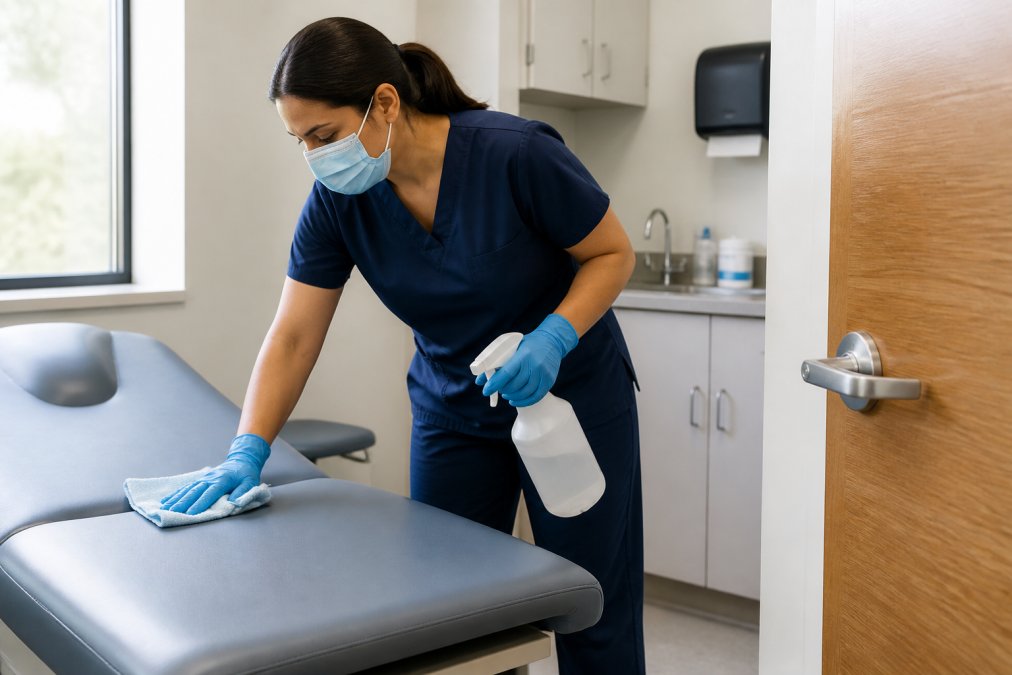
A medical facility disinfection checklist turns general rules into daily action. It tells staff exactly what to clean, how often, with what product, and for how long. Without one, cleaning becomes inconsistent and gaps go unnoticed, and gaps are what inspectors and infection control surveys look for first.
Build the Checklist Around Rooms, Not Just Surfaces
Most guides list surfaces. A stronger approach organizes the checklist by room type, because the sequence, product, and dwell time change from space to space. A workable structure looks like this:
| Room | Priority Surfaces | Typical Dwell Time | Frequency |
|---|---|---|---|
| Exam room | Exam table, armrests, blood pressure cuff, stethoscope, otoscope handle, doorknob, light switch | Match the EPA label, commonly 1-10 minutes depending on the product | Between every patient |
| Restroom | Faucet handles, toilet flush, door push plate, dispenser levers, sink basin | Label dwell time | Twice daily minimum, more in high-traffic hours |
| Waiting room | Chair arms, check-in kiosk, magazines (or remove them), door handles, water cooler | Label dwell time | Twice daily |
| Lab / specimen area | Countertops, centrifuge knobs, biohazard bin lids, phone handsets | Label dwell time | After each use |
| Administrative office | Shared keyboards, mice, phones, copier touchpad | Label dwell time | Daily |
High-Touch Surface Disinfection: Sequence and Tools
High-touch surfaces need disinfection at least once per shift, and more often in exam rooms between patients. These surfaces include:
- Doorknobs and push plates
- Light switches and thermostat dials
- Exam tables and armrests
- Blood pressure cuffs and stethoscopes
- Keyboards, phones, and check-in kiosks
- Faucet handles and soap dispensers
Medical Waste Disposal and Sterile Field Protection
Medical waste goes into clearly labeled, closable containers. Sharps go into puncture-resistant boxes. Never overfill a container, and never press down waste by hand.
| Waste Type | Container | Handling Rule |
|---|---|---|
| Sharps | Puncture-resistant box | Never recap needles |
| Blood-soaked items | Red biohazard bag | Double-bag if leaking |
| Regular trash | Standard bin | Keep separate from biohazard |
| Pharmaceutical waste | Labeled black container | Follow state rules |
Assign an Owner to Every Line
A checklist without an owner is a suggestion. Each line on the sheet should carry a role, front desk, medical assistant, or environmental services, and a sign-off field. At the end of the shift, the infection control lead reviews the sheet and flags any skipped line for follow-up. This is the difference between a checklist that documents work and one that documents intent.
Frequency of Cleaning in Medical Offices: A Practical Schedule
Cleaning frequency depends on the space and how it's used. Patient-facing areas need more attention than administrative offices. A practical schedule balances safety with staff time.
Many practices find this cadence works well:
- Between patients: exam tables, cuffs, and high-touch items in the room
- Twice daily: waiting room chairs, restrooms, and check-in counters
- Daily: floors, trash removal, and all patient care areas
- Weekly: vents, blinds, and less-touched surfaces
- Monthly: deep cleaning of carpets and upholstery
Train Staff and Build Standard Operating Procedures
Training is what separates a clean office from a compliant one. Every staff member who touches a surface, handles waste, or enters a patient room needs documented training.
- The product to use and its dilution ratio
- The contact time required
- The order of cleaning (top to bottom, clean to dirty)
- PPE required for the task
- What to do if something is missed or spilled
Track Compliance With Digital Hygiene Tools and Eco-Friendly Products
Paper checklists get lost, skipped, or signed without the work being done. Digital tracking tools solve that problem, and this is the angle most guides on medical office hygiene skip entirely. Staff scan a QR code on the exam room door or tap a task in an app, and the system records the time, location, and who completed it. That creates an audit trail you can pull up in seconds if a question comes up about whether a room was cleaned.
What to Look For in a Hygiene Tracking Tool
You do not need a hospital-grade platform. A workable tool for a small or mid-size practice typically offers:
- QR-code or NFC checkpoints placed in each room, restroom, and common area
- Photo verification for tasks where visual proof matters (for example, a reset exam room)
- Timestamped logs that export to PDF for inspection or accreditation reviews
- Exception alerts when a task is missed or logged late
- Role-based access so front desk, clinical staff, and environmental services see only their tasks
Eco-Friendly Products That Still Meet the Kill Claim
Eco-friendly products are gaining ground, and the good news is you do not have to trade efficacy for sustainability. Look for EPA-registered disinfectants with safer active ingredients, they still meet the same kill-claim standards as harsher formulas. The EPA's Safer Choice program lists products that meet its safety criteria, and the EPA's registered antimicrobial list is the authoritative source for verifying a product's claims.
Ventilation as Part of the Hygiene System
Ventilation matters too. Post-pandemic guidance from the CDC on improving ventilation recommends better airflow in clinical spaces. Practical steps include scheduling HVAC filter changes on a documented cadence, confirming that exam room exhaust vents are unobstructed, and using portable air cleaners with HEPA filters in rooms where procedures generate aerosols. Combine good ventilation with surface disinfection for a layered approach.
The Human Element: Burnout and Compliance
One issue few guides mention: staff burnout. Cleaning teams under pressure cut corners. Rotate tasks, provide breaks, and check in with your crew. A supported team cleans better than a rushed one. Digital tools help here too, when tasks are clearly assigned and fairly distributed, staff are less likely to feel that the burden falls on one person.
Digital tracking, eco-friendly products, and ventilation all support the same goal: consistent hygiene that holds up under inspection. Pick tools that make the work easier, not harder, and pilot before you commit.
Frequently Asked Questions
How often should a medical office be cleaned?
High-touch surfaces like exam tables, doorknobs, and light switches should be disinfected at least twice daily and between patient visits. Patient rooms need terminal cleaning after each infectious case. Common areas such as waiting rooms and restrooms require cleaning every four hours during operating hours. Floors and less-touched surfaces can be cleaned daily. Adjust frequency based on patient volume, the type of care provided, and your written exposure control plan.
What are the OSHA guidelines for medical office cleaning?
OSHA requires a written exposure control plan, annual bloodborne pathogens training for all staff with occupational exposure, and readily available PPE such as gloves, gowns, and eye protection. Contaminated sharps must go into closable, puncture-resistant containers. Regulated medical waste needs proper labeling and disposal. Handwashing facilities must be accessible, and surfaces must be decontaminated with an EPA-registered disinfectant according to the label's contact time.
What is the difference between cleaning, sanitizing, and disinfecting in a clinical setting?
Cleaning removes visible dirt, dust, and organic matter using soap or detergent. Sanitizing reduces bacteria to levels considered safe by public health standards. Disinfecting kills or inactivates pathogens on surfaces using an EPA-registered product. In a clinical environment, cleaning always comes first because disinfectants cannot penetrate dirt. Then apply the disinfectant and let it sit for the full contact time listed on the label before wiping.
What documentation is required for medical office sanitation compliance?
Keep a compliance manual that includes your exposure control plan, cleaning protocols, and safety data sheets for every chemical used. Maintain daily and weekly cleaning logs with initials, dates, and times. Record staff training certificates, PPE inventory checks, and any biohazard spill incidents. An audit trail of disinfectant use, including product name and contact time, helps during OSHA inspections and quality assurance reviews.