 ultimate-guide
OSHA Cleaning Standards in Clinics: A Step-by-Step Implementation Guide
Table of Contents
- Understanding OSHA Cleaning Standards for Clinical Environments
- OSHA Bloodborne Pathogens Standard Checklist for Daily Operations
- Medical Waste Disposal Regulations: Compliance and Documentation
- Infection Control Training Requirements for Clinic Staff
- Personal Protective Equipment and Hazard Communication Protocols
- Commercial Janitorial Insurance Requirements 2026
- Creating Your OSHA Cleaning Standards Implementation Plan
- Frequently Asked Questions
Last Updated: September 30, 2026
Understanding OSHA Cleaning Standards for Clinical Environments
OSHA cleaning standards clinics establish mandatory protocols for maintaining safe, sanitary environments where bloodborne pathogens and hazardous chemicals pose occupational risks. These are federal requirements that protect staff and patients from serious illness or injury.
Three interconnected rules form the foundation: the Bloodborne Pathogens Standard, the Hazard Communication Standard, and regulations governing regulated medical waste. Understanding how they interact is essential for genuine compliance.
Most violations stem from inherited protocols that haven't been verified against current OSHA requirements. Once you map your clinic's specific hazards, implementation becomes straightforward.
OSHA Bloodborne Pathogens Standard Checklist for Daily Operations
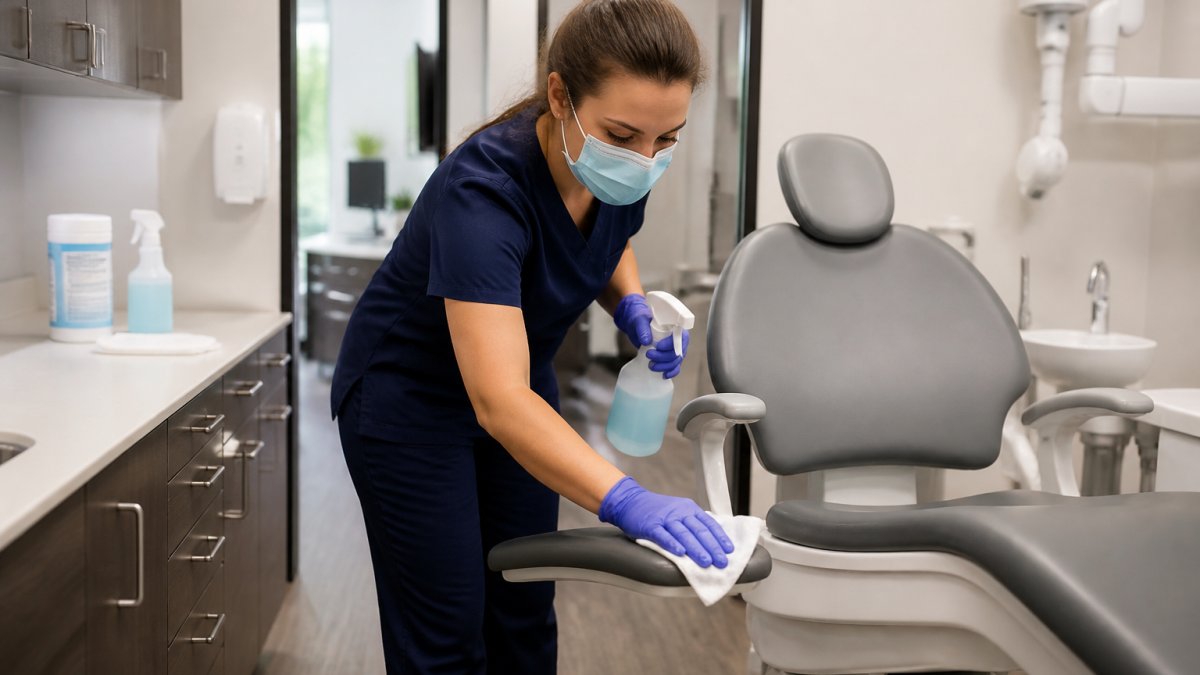
The OSHA Bloodborne Pathogens Standard requires clinical spaces be cleaned and disinfected on a schedule preventing cross-contamination. Identify high-touch surfaces requiring daily attention versus longer cycles. The standard requires disinfectants eliminate the pathogens your clinic encounters.
Your daily checklist should include these non-negotiable items:
-
High-touch surfaces in patient areas, door handles, light switches, examination table edges, armrests. Clean with appropriate disinfectant (typically a hospital-grade surface disinfectant) at minimum daily, more often if visibly soiled.
-
Clinical work surfaces, countertops where instruments or medications are prepared. These require disinfection after each patient, not once daily. Use a disinfectant appropriate for the surface material.
-
Floors in patient care areas, vacuum or sweep first to remove debris, then wet-mop with disinfectant solution. Frequency depends on foot traffic; high-volume clinics may need multiple passes daily.
-
Restrooms, toilet seats, faucet handles, soap dispensers, countertops. Daily disinfection minimum; high-traffic restrooms may need hourly attention.
-
Sharps containers and biohazard waste receptacles, exterior surfaces only. Never reach into containers. Disinfect the outside daily.
The standard requires documented cleaning schedules, your legal proof of compliance. Use paper logs or digital systems; consistency matters most.
Medical Waste Disposal Regulations: Compliance and Documentation
Regulated medical waste disposal is where many clinics stumble due to inadequate staff training and incident protocols. Your clinic generates several waste categories, each requiring different handling and response procedures for exposure or spillage.
Waste Categories and Container Requirements
Sharps go into rigid, puncture-resistant, biohazard-marked containers replaced when three-quarters full (the CDC). Once sealed, they're stored away from general trash until pickup in leak-proof, closable containers.
Pathological waste requires special containers and typically incineration. Most clinics contract this to licensed disposal companies. State regulations vary on incineration timing and storage conditions.
Pharmaceutical waste follows federal and state rules, often requiring incineration or reverse distribution. Never mix with other streams. Controlled substance disposal must be documented and witnessed per DEA guidelines.
Microbiological and infectious waste (cultures, specimens, contaminated materials) goes into clearly marked biohazard containers and is typically incinerated or autoclaved depending on your state's regulations. Autoclavable waste must be placed in bags that change color when sterilized, confirming proper treatment.
Post-Exposure Incident Response and Cleanup Protocol
OSHA requires a specific cleanup procedure for unexpected spills or exposure incidents, separate from routine disposal and documented immediately.
If a sharps container tips over or specimen container breaks:
- Isolate the area immediately with warning signs.
- Assess exposure risk; if staff were directly exposed, initiate exposure protocol simultaneously.
- Don appropriate PPE: nitrile gloves, eye protection, gown; use forceps for sharps.
- Contain liquid spills with absorbent material, then clean with EPA-registered disinfectant (typically 10 minutes contact time). Place sharps directly into containers using mechanical means.
- Dispose of cleanup materials as regulated medical waste.
- Document immediately: date, time, location, material, cleaning method, personnel present, and exposure status. This documentation is required by OSHA.
If exposure occurred, cleanup is secondary. The exposed employee must immediately wash the affected area with soap and water (or flush mucous membranes for 15 minutes if splashed), report to occupational health or emergency department for baseline testing and post-exposure prophylaxis evaluation, and receive incident documentation. Your clinic must have a written post-exposure incident response plan including source patient bloodborne pathogen status, baseline and follow-up testing schedules, and confidentiality protections, reviewed with staff annually.
Documentation and Vendor Management
Documentation is mandatory for all waste disposal. Your vendor must provide certificates of destruction for all regulated medical waste. Keep records for at least three years as proof of proper handling.
When selecting a vendor, verify state licensing, appropriate insurance, and their most recent inspection report. Establish a clear emergency pickup protocol for damaged containers and post their emergency contact number in clinical areas.
Audit vendor compliance annually. Request documentation of proper waste treatment (incineration temperatures, autoclave validation) and chain of custody procedures.
Infection Control Training Requirements for Clinic Staff
All staff who could encounter bloodborne pathogens must receive infection control training within 30 days of hire and annually thereafter. Training must cover bloodborne pathogen transmission, standard precautions, PPE selection and use, exposure control procedures, sharps safety, and cleaning protocols. Document attendance, dates, and content covered. OSHA violations occur when staff cannot explain basic precautions, regardless of training paid for.
Effective programs combine video instruction with hands-on demonstration. Cleaning staff must see how to safely handle sharps containers, not just watch videos.
Personal Protective Equipment and Hazard Communication Protocols
PPE requirements depend on tasks performed and hazards faced. The Hazard Communication Standard requires Safety Data Sheets (SDS) readily available for every chemical product. If contracting third-party cleaning, verify their PPE and chemical management protocols, a critical compliance responsibility many clinics overlook.
PPE Requirements by Task and Hazard Level
For in-house cleaning staff, PPE typically includes nitrile gloves, eye protection when handling liquid disinfectants, respiratory protection for aerosol disinfectants, and gowns if splashing is possible. Staff must know which PPE is required for each task and why.
Document task-specific PPE in your cleaning protocol manual: daily surface disinfection (nitrile gloves, eye protection); floor cleaning (nitrile gloves, closed-toe shoes, eye protection); sharps/biohazard areas (nitrile gloves, eye protection, gown, closed-toe shoes); restrooms (nitrile gloves, eye protection, gown, closed-toe shoes); aerosol disinfectants (NIOSH-approved respiratory protection, nitrile gloves, eye protection, gown).
Your Hazard Communication program must include container labeling, SDS maintenance for every product, staff training on labels and SDS documents, chemical exposure incident reporting procedures, and documentation of training. Keep SDSs accessible to all staff in both physical and digital formats.
Vendor Vetting Criteria for Third-Party Cleaning Services
When outsourcing cleaning, your clinic remains responsible for OSHA compliance. Audit the vendor's PPE protocols, chemical management, and training before contracting and periodically during engagement.
Before contracting, require the vendor to provide: (1) written medical facility-specific cleaning protocols addressing EPA-registered disinfectants, area-specific cleaning frequency, sharps/biohazard handling, PPE requirements, and post-exposure procedures; (2) proof of OSHA-compliant bloodborne pathogen and hazard communication training within the past year; (3) Safety Data Sheets for all products; (4) current insurance documentation with your clinic named as additional insured and coverage for medical facility cleaning; (5) background check and licensing verification; (6) references from at least two other medical facilities.
Ongoing Vendor Compliance Monitoring
Establish ongoing monitoring: monthly observations of PPE use and protocol compliance, quarterly audits of cleaning logs and product usage, annual training verification, and incident reporting protocols. Address non-compliance immediately in writing with required corrective action timelines. Terminate contracts for continued non-compliance.
Chemical Inventory and SDS Management
Maintain a current inventory of all cleaning chemicals used in your facility, whether applied by in-house staff or contractors. This inventory should list:
- Product name and manufacturer
- Location where it is stored and used
- Intended use (surface disinfection, floor cleaning, etc.)
- Dilution ratio if concentrated
- Required PPE for safe use
- Contact information for the manufacturer (for emergency inquiries)
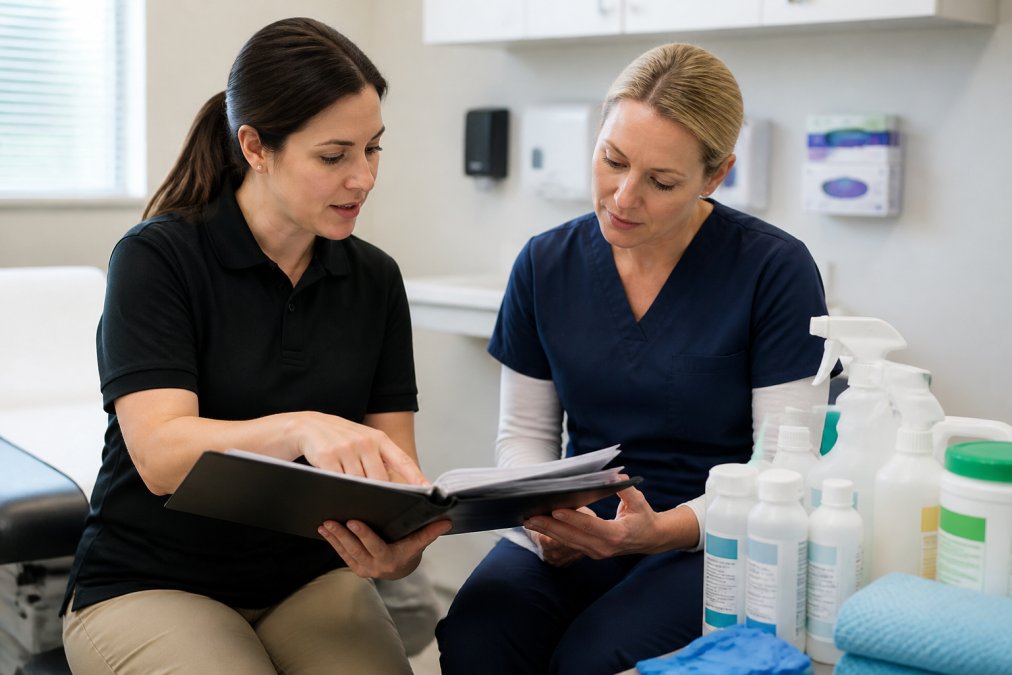
Store SDSs in a format accessible to all staff. Many clinics use a combination of physical binders (in the cleaning supply area) and digital storage (shared drive or cloud-based SDS management system). Ensure staff know where to find SDSs and how to use them. Include SDS review as part of your annual training.
Commercial Janitorial Insurance Requirements 2026
Your cleaning operations, whether performed in-house or contracted, require appropriate insurance coverage. General liability insurance covers bodily injury and property damage claims but doesn't cover professional liability or errors in cleaning protocols. Most clinics that contract with janitorial companies require those companies to carry commercial general liability insurance with the clinic named as an additional insured.
In 2026, standard coverage limits for commercial janitorial services typically range based on contract size and risk level. More importantly, your vendor's insurance must actually cover medical facility cleaning. Some general janitorial policies specifically exclude healthcare environments due to the heightened hazard profile.
If you employ cleaning staff directly, you'll need workers' compensation insurance.
Creating Your OSHA Cleaning Standards Implementation Plan
Start by conducting a hazard assessment specific to your clinic to ensure OSHA cleaning standards clinics require. Walk through each area and identify where bloodborne pathogens or hazardous chemicals could be encountered. Patient care areas require different protocols than administrative offices. Restrooms have different risks than examination rooms.
Frequently Asked Questions
What is the difference between cleaning, disinfecting, and sterilizing under OSHA standards?
Cleaning removes visible dirt and organic material using soap and water. Disinfecting uses chemical agents to kill pathogens on surfaces but does not eliminate all microorganisms. Sterilization destroys all microorganisms and spores, typically through heat or chemical processes. OSHA requires all three depending on the surface and its contact with patients or bloodborne pathogens. High-touch surfaces in clinical areas need disinfection; surgical instruments require sterilization.
What are the OSHA requirements for handling hazardous waste in clinics?
OSHA requires clinics to establish an exposure control plan, use designated biohazardous waste containers (typically red bags or sharps containers), label all hazardous materials per the Hazard Communication Standard, and maintain chain of custody documentation. Staff must receive training on proper segregation, storage, and disposal procedures. Sharps must go into puncture-resistant containers; regulated medical waste into labeled red bags. All waste must be stored in designated areas away from patient and public spaces.
How often should OSHA cleaning standards be audited in a clinical setting?
OSHA does not mandate a specific audit frequency, but best practice is quarterly compliance audits to verify staff adherence, proper documentation, and protocol updates. Monthly spot-checks of high-touch surfaces, sharps containers, and waste storage areas help catch gaps early. Many clinics conduct audits after staff turnover or when infection control incidents occur. Documentation of all audits is critical for demonstrating due diligence during OSHA inspections.
What training documentation must clinics maintain for OSHA compliance?
Clinics must document all bloodborne pathogen training with dates, content covered, attendees, and trainer credentials. Records must be kept for at least three years and include initial training plus annual refresher courses. Documentation should cover exposure control procedures, proper use of PPE, sharps safety, waste disposal, and post-exposure response protocols. OSHA inspectors will request these records, so maintain them in an organized, accessible format that shows consistent staff participation.