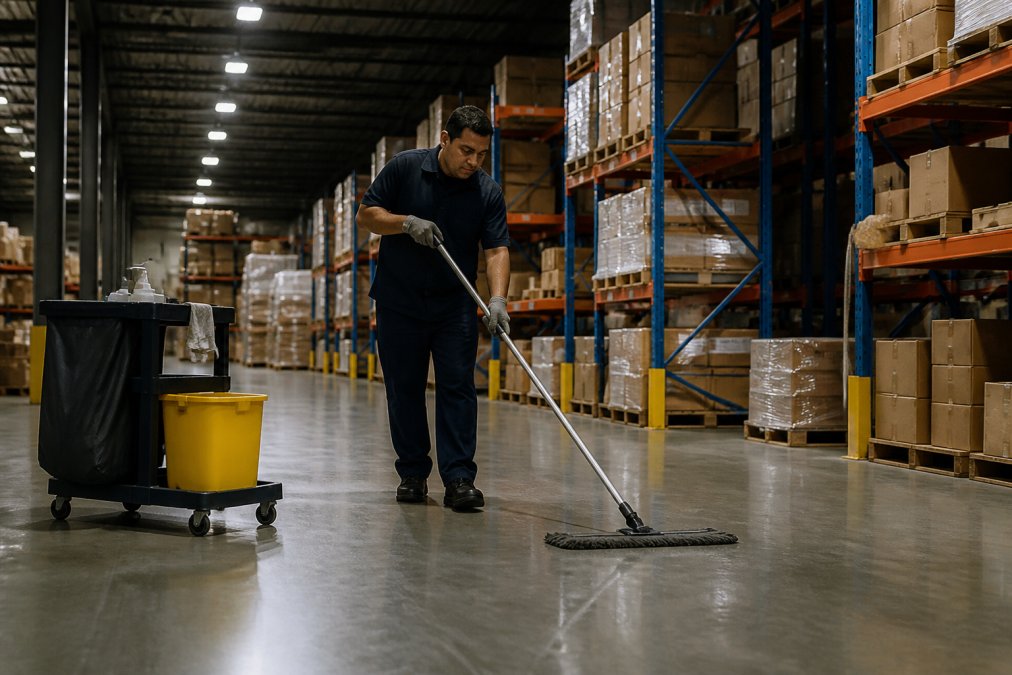
 ultimate-guide
Reliable Overnight Cleaning Services for Warehouses
Table of Contents
- What Reliable Overnight Cleaning Services for Warehouses Include
- Benefits of Overnight Janitorial Services for Industrial Facilities
- OSHA Warehouse Cleaning Standards Your Provider Should Follow
- Warehouse Cleaning Cost Per Square Foot: What Drives the Number
- Flexible Scheduling and Overnight Crew Reliability
- Sustainable Cleaning Protocols for Industrial Spaces
- Conclusion
- Frequently Asked Questions
Last Updated: September 25, 2026
What Reliable Overnight Cleaning Services for Warehouses Include
Reliable overnight cleaning services for warehouses are scheduled janitorial programs performed after operating shifts end, covering high-level dusting, floor care, racking and loading dock cleaning, and debris removal before the next shift begins. At Broughton Commercial Cleaning, we build these programs around one principle: the crew works while the facility sleeps, and the floor is ready when the first forklift rolls.
High-Level Dusting and Overhead Cleaning
Floor Care, Racking, and Loading Dock Cleaning
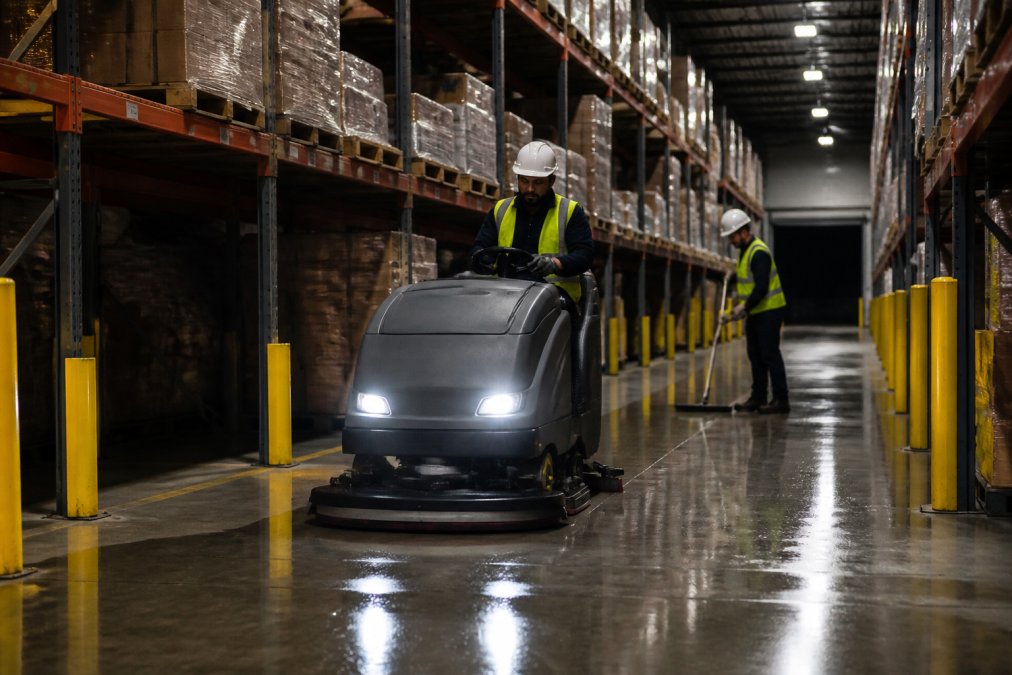
Floor care is the backbone of any warehouse sanitation program. Concrete floors in industrial spaces collect rubber marks, oil residue, and fine dust that a mop cannot lift.
A proper program includes:
- Floor scrubbing with ride-on or walk-behind machines on a set rotation
- Floor stripping and waxing in finished zones such as offices and pick stations
- Industrial degreasing around machinery, forklift lanes, and battery charging areas
- Racking system cleaning between and beneath beams, where product dust collects
- Loading dock cleaning, including debris removal, dock levelers, and trailer paths
Benefits of Overnight Janitorial Services for Industrial Facilities
The main benefit of overnight janitorial services is that cleaning happens without interrupting production. For multi-shift operations, that alone justifies the schedule.
The secondary benefits compound over time:
- Safer floors and aisles. Debris removal and floor scrubbing reduce slip and trip hazards that drive workplace injury claims.
- Better air quality. Regular high-level dusting lowers airborne particulates that settle on inventory and into equipment.
- Longer equipment life. Dust is abrasive. Motors, conveyors, and HVAC systems last longer when intakes stay clear.
- Audit readiness. A documented cleaning schedule supports compliance and facility audit requirements without a scramble.
OSHA Warehouse Cleaning Standards Your Provider Should Follow
OSHA does not publish a single warehouse cleaning rulebook. Instead, sanitation and housekeeping obligations sit across several general industry standards in 29 CFR Part 1910, and a competent provider should be able to explain, in writing, how their overnight program maps to each one. This is the compliance checklist most janitorial contracts never put on paper.
The standards that actually apply
- Walking-working surfaces (29 CFR 1910.22). Aisles, dock areas, passageways, and storage areas must be kept clean, orderly, and in a sanitary condition. Spills and debris must be addressed promptly, and the standard requires that "every floor, working place, and passageway" be maintained free from hazards.
- Sanitation (29 CFR 1910.141). Waste must be removed regularly, and work areas kept free of accumulated debris. This is the standard that covers trash handling, potable water, and restroom sanitation in a general industry facility.
- Hazard communication (29 CFR 1910.1200). Any cleaning crew working around stored chemicals, or using their own, needs access to safety data sheets (SDS) and proper container labeling. If your provider cannot produce an SDS binder for the products they bring on site, that is a finding waiting to happen.
- Personal protective equipment (29 CFR 1910.132 and 1910.138). Providers should supply and enforce PPE appropriate to the site, including eye protection, chemical-resistant gloves, and slip-resistant footwear. The employer, not the crew member, is responsible for the hazard assessment.
- Powered industrial trucks (29 CFR 1910.178). If your overnight crew operates a ride-on scrubber or works in active forklift lanes, traffic-control and pedestrian-safety procedures apply.
What a compliance-ready overnight program looks like
A provider that treats OSHA as part of the scope, not an add-on, will hand you a document set before the first shift. Ask for:
- A written scope that names the standards above and the specific tasks that satisfy each one.
- A spill-response procedure with the sequence, isolate, contain, clean, report, and the equipment staged on site.
- A chemical inventory and SDS access plan for every product the crew brings in.
- A PPE matrix by task, not a generic "PPE provided" line.
- A training log showing crew members have been trained on hazard communication and bloodborne pathogens (29 CFR 1910.1030) if restrooms or first-aid areas are in scope.
- An incident-reporting path so a near-miss on your floor gets documented and routed to your safety manager.
The inspection angle most facility managers miss
OSHA inspections in warehousing are frequently triggered by a complaint, a serious injury, or a referral, not a scheduled audit. When an inspector walks the floor, housekeeping is one of the first things documented. A dated, signed cleaning log showing nightly floor care, overhead dusting on rotation, and dock-area debris removal is the difference between a clean record and a citation. Build that log into the contract from day one.
Warehouse Cleaning Cost Per Square Foot: What Drives the Number
Warehouse cleaning cost per square foot depends on four variables: facility size, dust and debris load, equipment density, and service frequency. Pricing is quoted per square foot because it scales predictably across large footprints, but the per-square-foot rate is a starting point, not the whole quote.
How the number is built
A typical overnight warehouse program is priced in three layers:
- Base janitorial, restrooms, break rooms, offices, and trash. This is the smallest slice of the total in a large facility.
- Production-floor care, floor scrubbing, aisle sweeping, and debris removal on a set rotation. This is where the bulk of labor hours go.
- Periodic and project work, high-level dusting, racking cleaning, dock cleaning, and floor stripping and waxing. These are usually quoted separately because they run on a rotation, not nightly.
What actually moves the number up or down:
| Cost Driver | Lower Cost | Higher Cost |
|---|---|---|
| Facility size | Large open footprint | Many small rooms and offices |
| Dust and debris load | Light, sealed inventory | Heavy dust, manufacturing residue |
| Equipment density | Open aisles | Dense racking, conveyors, machinery |
| Frequency | Weekly floor care | Nightly full-service program |
| Access | Single-shift operation | 24/7 operation with narrow windows |
| Floor type | Sealed concrete | VCT or finished flooring needing wax |
What to ask for in a quote
A quote you can actually compare against another quote should break out:
- Square footage in scope, and whether it is gross building area or cleanable area. The two can differ by 20% or more in a racked facility.
- Frequency per task, nightly, weekly, monthly, quarterly. A low rate with monthly floor care is not the same service as a higher rate with nightly floor care.
- Labor hours committed, the single best predictor of what actually gets done.
- Exclusions, overhead dusting, racking, and dock areas are the first items cut to hit a low headline rate.
- Term and escalation, whether the rate is locked for the term or adjusts annually.
Service areas and getting a free estimate
Overnight coverage is a route-density business. A provider with crews already working in your industrial corridor can price a facility more competitively than one driving an hour each way, and can respond faster when a crew member calls out. When you request a quote, ask two questions: which facilities near mine do you already service overnight, and what is your guaranteed response time for an emergency call?
Flexible Scheduling and Overnight Crew Reliability
Flexible scheduling is what separates a provider that fits your operation from one that disrupts it. Warehouses run on shifts, and cleaning windows have to match.
What to look for:
- Overnight janitorial windows aligned to your shift change, not the provider's convenience
- Day porter coverage for high-traffic periods, restrooms, and spill response
- 24/7 availability for emergency calls such as water intrusion or post-incident cleanup
- Consistent crew assignment so the same background-checked staff learn your site
Sustainable Cleaning Protocols for Industrial Spaces
Sustainable cleaning in industrial settings is about reducing chemical load and waste without lowering hygiene standards. It is a growing requirement for facilities with environmental reporting obligations.
Practical protocols include:
- Concentrated, diluted-on-site chemicals that cut packaging waste and shipping weight
- Green-certified disinfectants for high-touch and food-adjacent zones
- Microfiber systems that use less water and fewer chemicals per square meter
- Waste segregation and disposal aligned to your recycling and hazardous waste streams
- Equipment maintenance to extend machine life and reduce replacement waste
Conclusion
The hardest part of overnight warehouse cleaning is not the cleaning itself. It is finding a provider that shows up, follows safety protocols, and treats your facility audit as seriously as you do.
Frequently Asked Questions
How much does it cost to clean a warehouse?
Warehouse cleaning cost per square foot depends on square footage, floor type, racking density, and how often crews visit. A 50,000-square-foot facility with weekly service costs less per square foot than a smaller site needing nightly high-level dusting. Broughton Commercial Cleaning provides upfront written quotes in plain language, so the price you see is the price you pay. Visit the website for a free quote.
What are the benefits of overnight janitorial services for industrial facilities?
Overnight janitorial services let crews work during non-operating shifts, so production, forklift traffic, and shipping schedules are never interrupted. Floors get scrubbed and dried before the first shift arrives, reducing slip hazards. Dust and debris are removed before they settle into equipment. Facilities also avoid paying overtime for daytime disruptions. For multi-shift operations, overnight cleaning keeps every shift starting in a clean, safety-compliant space.
What safety standards should warehouse cleaning services follow?
Providers should follow OSHA warehouse cleaning standards, including proper lockout/tagout awareness around powered equipment, safe ladder use for high-level dusting, and chemical handling per SDS requirements. Crews should wear PPE appropriate to the task and use wet-floor signage during floor scrubbing. A reliable provider documents safety protocols and carries licensing, insurance, and bonding. Ask for a facility audit before work begins so hazards like blind corners and loading dock edges are mapped in advance.
How often should a warehouse be cleaned?
Most warehouses need daily attention in break rooms, restrooms, and high-traffic aisles, with weekly or monthly deep cleaning for racking, overhead beams, and floor stripping and waxing. Facilities handling food, pharmaceuticals, or fine dust may need nightly disinfection services and debris removal. A site assessment determines the right frequency based on operating shifts, debris volume, and compliance requirements. Preventative maintenance schedules prevent dust buildup that can trigger OSHA citations or equipment failure.