 ultimate-guide
OSHA Cleaning Guidelines: A 2026 Compliance Guide
Table of Contents
- What OSHA Cleaning Guidelines Cover
- OSHA Sanitation Standards and Housekeeping Rules
- OSHA Hazard Communication Standard for Cleaning Chemicals
- Personal Protective Equipment and Respiratory Protection
- OSHA Bloodborne Pathogens Standard for Cleaning Staff
- Commercial Janitorial Insurance Requirements 2026
- Employee Training and Compliance Audits
- Industry-Specific Cleaning Checklists
- Frequently Asked Questions
Last Updated: September 23, 2026
What OSHA Cleaning Guidelines Cover
The OSHA cleaning guidelines establish mandatory standards for maintaining safe, sanitary workplaces across all industries. These standards address everything from basic housekeeping to hazardous chemical handling, bloodborne pathogen exposure, and employee training requirements. Understanding what OSHA cleaning guidelines require is essential for facility managers, operations teams, and anyone responsible for workplace sanitation.
OSHA cleaning requirements span multiple standards: the General Duty Clause (Section 5(a)(1)), sanitation (1910.141), hazard communication (1910.1200), bloodborne pathogens (1910.1030), and personal protective equipment (1910.132).
Different workplace types trigger different requirements. A medical facility faces bloodborne pathogen protocols, an industrial warehouse must manage post-construction dust and debris, and an office building needs high-touch surface disinfection.
This guide covers sanitation standards, chemical safety, PPE requirements, and training and auditing processes that keep your facility inspection-ready.
OSHA Sanitation Standards and Housekeeping Rules
OSHA's sanitation standard (1910.141) requires all places of employment be kept clean and orderly. Cluttered floors cause trips and falls, contaminated surfaces spread illness, and improper waste disposal creates fire and chemical hazards.
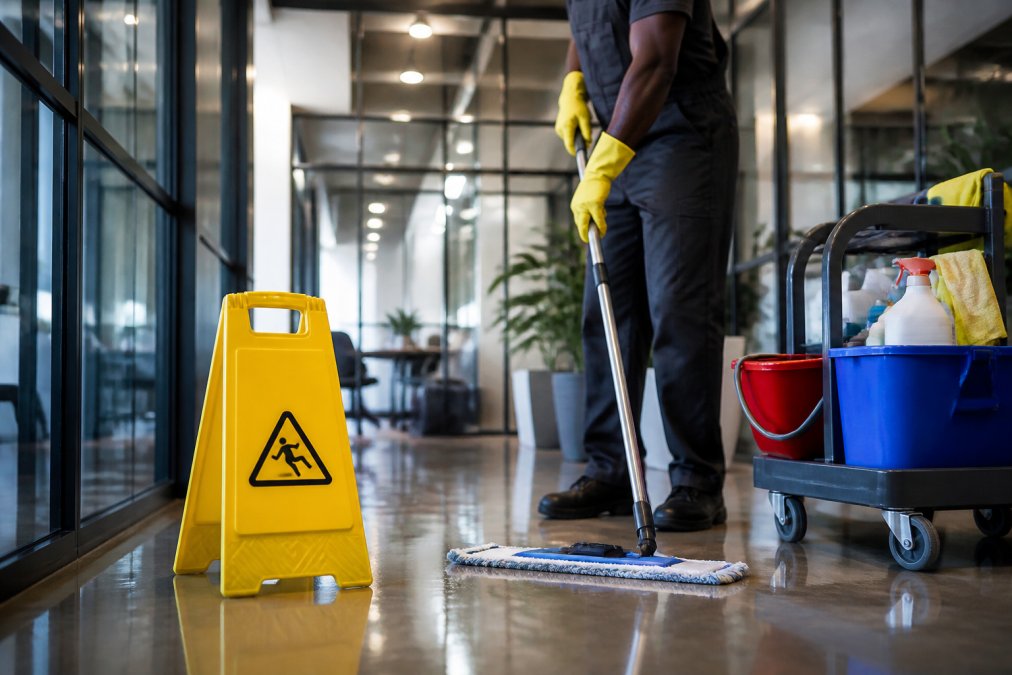
Floors must be cleaned regularly and kept dry. Walking surfaces must be free of debris, spills, and obstructions. Cleaning frequency depends on the type of work performed and hazards present.
High-Touch Surface Cleaning Frequency
High-touch surfaces, doorknobs, light switches, handrails, elevator buttons, desks, and shared equipment, require more frequent cleaning because they're transmission points for pathogens and bacteria. OSHA requires cleaning frequency sufficient to prevent hazard accumulation.
High-touch surfaces in office environments should be cleaned at least daily, more frequently in healthcare or food service settings. The key is establishing a routine and documenting it for inspection purposes.
Restroom surfaces require more frequent attention than office hallways. Surfaces in medical facilities where bloodborne pathogen exposure is possible require protocols beyond standard cleaning.
Waste Management and Disposal
Waste must be stored in designated areas and removed regularly to prevent accumulation, odors, pest attraction, and fire hazards. Hazardous waste requires special handling and disposal procedures.
Trash receptacles must be kept clean and in good repair. Chemical waste requires certified hazardous waste disposal services, not standard municipal waste streams.
Biohazardous waste in medical or laboratory settings requires containment in marked, leak-proof containers and disposal through licensed medical waste disposal companies.
OSHA Hazard Communication Standard for Cleaning Chemicals
The OSHA Hazard Communication Standard (HCS, 1910.1200) requires all chemical hazards be communicated to employees through labels, Safety Data Sheets (SDS), and training. Employees must know what chemicals they're exposed to and what risks those chemicals pose.
Employers must ensure all containers are labeled, SDS documents are readily accessible, and employees receive training on chemical hazards before handling them.
Safety Data Sheet (SDS) Requirements
Every cleaning chemical must have a current SDS on file and readily accessible to employees during their work shift. Digital access counts, but it must be genuinely accessible, not locked behind passwords or difficult-to-navigate systems.
The SDS contains 16 standardized sections covering product identification, hazards, composition, first-aid measures, handling, storage, PPE, and disposal. When an employee is exposed to a chemical or becomes ill, the SDS is the first document you reference.
Maintaining current SDSs is a compliance requirement frequently cited during inspections. When you switch suppliers or introduce new chemicals, updating your SDS file is critical.
Chemical Labeling and Employee Access
Every container must be labeled with the product name, hazard warnings, and manufacturer's information. Unmarked spray bottles are a common violation.
Employee access to hazard information must be genuine and immediate. Digital access through a company intranet or cloud-based system is acceptable if employees have reliable access during shifts. QR codes on chemical containers that link to the SDS work well for compliance and training.
Employees must receive training on reading labels and SDSs, recognizing hazard symbols, and responding to chemical exposure before handling chemicals and whenever new chemicals are introduced.
Personal Protective Equipment and Respiratory Protection
OSHA's PPE standard (1910.132) requires employers to provide appropriate personal protective equipment. For cleaning staff, this typically includes gloves, eye protection, respiratory protection, and sometimes specialized equipment like aprons or shoe covers.
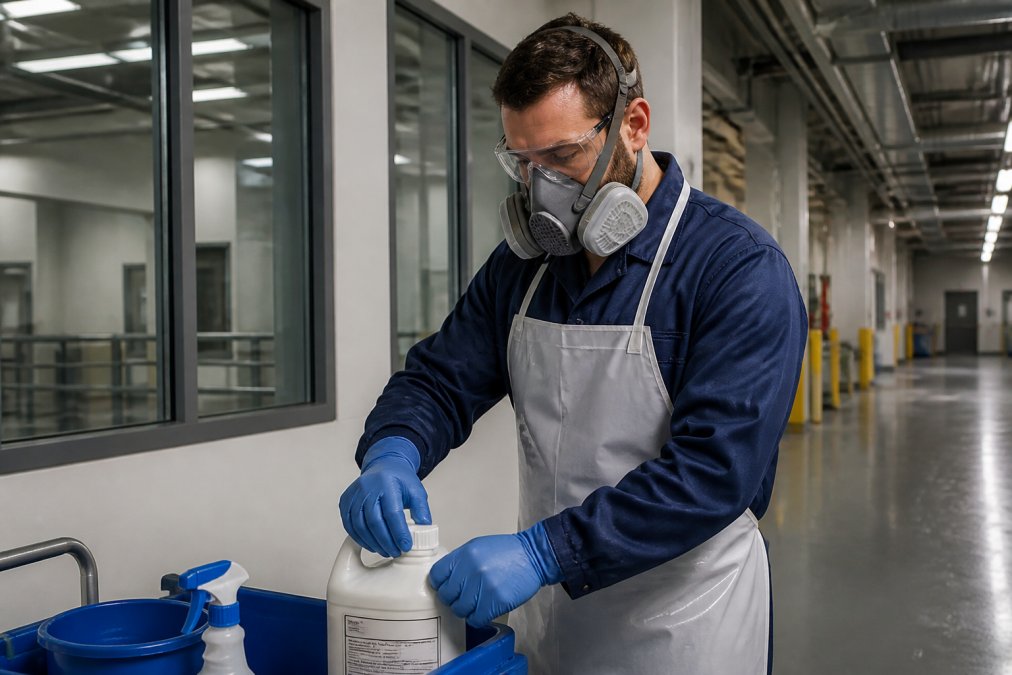
Employers must determine hazards, select appropriate PPE, ensure proper fit, train employees, and maintain equipment. PPE is the last line of defense when hazards cannot be eliminated through other means.
OSHA's respiratory protection standard (1910.134) requires hazard assessment, respirator selection, fit testing, training, and medical evaluation. Employees must be medically cleared, fit-tested, and trained on proper use and limitations.
Proper respiratory protection requires certified equipment, documented fit testing, and ongoing training. Violations in this area carry significant penalties.
OSHA Bloodborne Pathogens Standard for Cleaning Staff
The OSHA Bloodborne Pathogens Standard (1910.1030) applies to medical facilities, dental offices, laboratories, and any environment where bloodborne pathogen exposure is reasonably anticipated.
The standard requires exposure control plans identifying job classifications with potential exposure, methods to reduce exposure, and training and medical follow-up for exposed employees.
Exposure control includes using standard precautions, treating all blood and OPIM as if they're infectious, proper handling and disposal of contaminated materials, use of appropriate PPE, and immediate response to exposures.
Commercial Janitorial Insurance Requirements 2026
Beyond OSHA compliance, facilities using commercial janitorial services should verify that their cleaning contractor carries appropriate insurance. General liability insurance protects against property damage and bodily injury claims. Workers' compensation insurance covers injuries to cleaning staff. Professional liability insurance covers errors or omissions in service delivery.
Employee Training and Compliance Audits
OSHA compliance depends on employee training and ongoing verification that standards are being met. Training must cover the specific hazards present in your workplace, how to recognize those hazards, what controls are in place, how to use PPE, and what to do if an exposure occurs.
Annual Safety Training Requirements
Employees must receive training before they begin work and whenever new hazards are introduced. The training must be documented, you need records showing who was trained, what was covered, when the training occurred, and who delivered it. Annual refresher training is recommended for all employees, and it's required whenever there are changes to procedures, chemicals, or equipment.
Conducting Safety Audits
Regular safety audits verify that cleaning procedures are being followed and that hazards are being controlled. An audit typically includes a walkthrough inspection of all areas where cleaning occurs, review of cleaning procedures and documentation, verification that chemicals are properly labeled and SDSs are accessible, inspection of PPE and equipment, and interviews with cleaning staff about their training and understanding of safety procedures.
| Audit Component | Frequency | Documentation |
|---|---|---|
| Walkthrough inspection | Quarterly | Photos, notes, checklist |
| Chemical inventory and SDS review | Quarterly | SDS file audit, label verification |
| PPE inspection and fit testing | Annually | Fit test records, equipment inventory |
| Employee interviews | Annually | Training records, knowledge assessment |
| Corrective action follow-up | As needed | Deficiency log, completion verification |
Industry-Specific Cleaning Checklists
Different industries face different cleaning and compliance requirements. A one-size-fits-all approach won't work, your facility's specific environment determines which standards apply and what compliance looks like.
Medical Facilities and Infection Control
Medical facilities must comply with OSHA standards plus additional infection control requirements from healthcare regulatory bodies. Cleaning procedures must prevent cross-contamination between patient care areas, and certain areas require specialized disinfection protocols. High-touch surfaces in patient care areas, restrooms, and common areas require frequent cleaning with EPA-registered disinfectants.
Industrial Facilities and Post-Construction Cleanup
Industrial facilities and construction sites present different hazards. Post-construction cleanup requires removal of dust, debris, and hazardous materials like lead paint dust or asbestos fibers. Cleanup procedures must prevent employee exposure and ensure that hazardous materials are properly disposed of.
Frequently Asked Questions
What are the OSHA requirements for cleaning supplies?
OSHA requires that all cleaning chemicals be accompanied by Safety Data Sheets (SDS), clearly labeled with hazard information, and stored safely. Employers must ensure staff receive training on chemical hazards, proper handling, and emergency procedures. The Hazard Communication Standard mandates that workers understand exposure limits and know how to respond to chemical spills or exposure incidents.
How often should high-touch surfaces be cleaned according to OSHA guidelines?
OSHA's General Duty Clause requires facilities to maintain clean, sanitary conditions. High-touch surfaces like door handles, light switches, and handrails should be cleaned and disinfected daily, or more frequently in high-traffic areas or medical settings. Post-pandemic best practices recommend multiple cleanings throughout the day in facilities with heavy foot traffic or vulnerable populations.
What does the OSHA Bloodborne Pathogens Standard require for cleaning staff?
The Bloodborne Pathogens Standard (29 CFR 1910.1030) requires employers to provide cleaning staff with appropriate PPE, including gloves and eye protection when handling biohazardous materials. Staff must receive training on pathogen control, proper disposal of contaminated materials, and use of EPA-registered disinfectants. Employers must provide hepatitis B vaccination at no cost to exposed employees.
What insurance coverage do commercial janitorial companies need in 2026?
Commercial janitorial insurance typically includes general liability (covering bodily injury and property damage), workers' compensation (required in most states), and specialized coverage for chemical handling and bloodborne pathogen exposure. Coverage amounts vary by facility type and contract terms. Verify your cleaning provider maintains current insurance and bonding to protect your facility and staff.
Does OSHA specify which disinfectants must be used in commercial facilities?
OSHA does not mandate specific disinfectant brands, but requires that facilities use EPA-registered disinfectants appropriate for their environment. The chemical must be effective against pathogens relevant to that facility type. Medical facilities must follow stricter protocols than general offices. All disinfectants must have accessible Safety Data Sheets and staff must be trained on proper application and safety precautions.
What are the most common OSHA violations in janitorial work?
Common violations include inadequate chemical labeling, missing or incomplete Safety Data Sheets, failure to provide proper PPE or respiratory protection, inadequate employee training on hazard communication, and poor housekeeping that creates slip-and-fall hazards. Many facilities also fail to maintain records of safety audits or employee training. Regular compliance reviews help identify and correct these issues before OSHA inspections occur.