 blog
blog
7 Best Practices for High Traffic Office Cleaning
Table of Contents
- Why High Traffic Office Cleaning Requires a Different Approach
- 1. Build an Office Cleaning Checklist for Managers That Covers Every Zone
- 2. Match Commercial Cleaning Frequency Standards to Real Foot Traffic
- 3. Choose the Right Commercial Cleaning Equipment for High-Traffic Areas
- 4. Control Entry Points with Mats and Spot-Cleaning Protocols
- 5. Prevent Cross-Contamination with Color-Coded Microfiber Systems
- 6. Clean Without Disrupting Business Operations
- 7. Train Staff, Track Results, and Budget for Consistency
- Frequently Asked Questions
Last Updated: September 21, 2026
Why High Traffic Office Cleaning Requires a Different Approach
High traffic office cleaning is the practice of adjusting cleaning frequency, tools, and protocols to match how many people actually use a space each day. A lobby with 400 daily visitors needs a different routine than a storage room with four. We've watched offices waste budget on uniform cleaning schedules that ignore occupancy entirely.
CDC guidance on cleaning and disinfecting facilities
1. Build an Office Cleaning Checklist for Managers That Covers Every Zone
An office cleaning checklist for managers is a written, zone-specific task list that assigns each cleaning job a frequency and an owner. Without one, cleaning becomes reactive: someone notices a dirty restroom and calls it in.
Daily, Weekly, and Monthly Tasks
Daily tasks cover restrooms, entry glass, trash, and high-touch surfaces. Weekly tasks add floor care, dusting above eye level, and break room deep cleaning. Monthly tasks include carpet extraction, vent dusting, and equipment wipe-downs.
Zone-by-Zone Breakdown
Split your floor plan into zones: entry and lobby, workstations, restrooms, break rooms, and shared equipment areas. Each zone gets its own task list and sign-off sheet.
| Zone | Daily Tasks | Weekly Tasks | Monthly Tasks |
|---|---|---|---|
| Entry and lobby | Glass, entry mats, high-touch surfaces | Floor buffing, furniture dusting | Carpet extraction, light fixtures |
| Restrooms | Disinfect fixtures, restock supplies, mop | Grout scrubbing, vent dusting | Deep sanitization, drain treatment |
| Break rooms | Counters, sinks, trash, appliance handles | Refrigerator cleaning, floor care | Appliance interiors, cabinet fronts |
| Workstations | Trash, spot cleaning | Dusting, chair wipe-down | Carpet care, vent cleaning |
2. Match Commercial Cleaning Frequency Standards to Real Foot Traffic
Commercial cleaning frequency standards should be set by measured occupancy, not by square footage alone. Two offices of identical size can need completely different schedules.
Lobby and Reception Areas
Reception desks, door handles, and elevator buttons collect contact constantly. These surfaces need disinfection at least twice daily in busy buildings.
Restrooms and Break Rooms
Restrooms in high-occupancy offices often need two or three service visits per day. Break room counters and appliance handles deserve the same attention, especially during lunch hours.
3. Choose the Right Commercial Cleaning Equipment for High-Traffic Areas
Commercial cleaning equipment for high-traffic areas needs to survive constant use and clean fast. Labor is the largest line item in most office cleaning budgets, so every tool decision is really a labor decision. The right equipment cuts minutes per zone; the wrong equipment adds them back in repairs, rework, and crew fatigue.
Core Equipment by Zone
- Commercial upright vacuums with HEPA filtration for carpeted entries and hallways. Look for a cord length that reaches an entire floor from one outlet and a brush roll rated for continuous duty, residential-grade vacuums typically fail within months under commercial load.
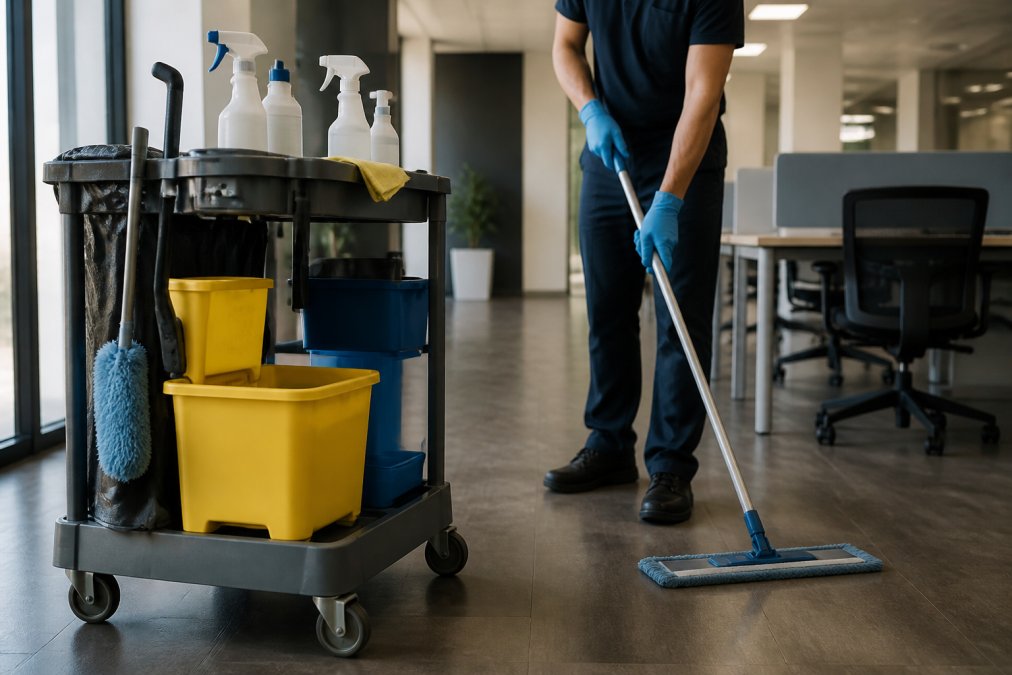
- Wide microfiber flat mops (18-24 inch) that cover more floor per pass and can be laundered hundreds of times before losing pickup.
- Walk-behind auto-scrubbers for large hard-floor lobbies and corridors. Battery-powered units let crews work near occupied desks without cords or exhaust.
- Color-coded microfiber cloths to separate restroom and food-area cleaning (see Section 5).
- Non-slip wet-floor signs and a dedicated spill kit staged in each zone, not locked in a supply closet.
Matching Equipment to Foot Traffic
A common pattern is to size equipment to the busiest zone, not the average. A lobby with 400 daily entries needs an auto-scrubber and a wide mop; a 12-person satellite office does not. Over-buying equipment for low-traffic zones ties up capital that would be better spent on mid-day porter coverage.
The Technology Layer Most Programs Skip
Smart-cleaning tools are still rare in office programs, which is exactly why they are worth a look. Three categories are mature enough for commercial use:
- Occupancy sensors and people counters at entries and restroom doors. These feed actual usage data into your schedule instead of relying on a manager's guess.
- IoT trash and supply sensors that alert crews when a bin is full or a dispenser is low, so restroom visits happen on demand rather than on a fixed clock.
- Connected scrubbers and vacuums that log run time, battery cycles, and cleaning paths, giving facility managers a verifiable record of what was actually cleaned.
Safety and Ergonomics
OSHA guidance on workplace safety and health applies directly to equipment choices. Backpack vacuums, wide mops, and scrubbers all shift ergonomic risk, and wet floors create slip hazards for both crews and tenants. Choose tools that reduce repetitive strain and always pair wet work with proper signage.
4. Control Entry Points with Mats and Spot-Cleaning Protocols
Entry mats stop most tracked-in soil before it reaches your floors. A proper matting system runs 10 to 15 feet from the door, with a scraper mat outside and an absorbent mat inside. This traps grit, moisture, and road salt at the threshold.
5. Prevent Cross-Contamination with Color-Coded Microfiber Systems
Cross-contamination happens when the same cloth or mop moves from a restroom to a break room. Color-coded microfiber systems stop that transfer by assigning a color to each zone.
A typical system:
- Red: restrooms and toilets
- Yellow: sinks, counters, and food-contact surfaces
- Blue: general surfaces, desks, and glass
- Green: break room and kitchen areas
6. Clean Without Disrupting Business Operations
7. Train Staff, Track Results, and Budget for Consistency
Training, tracking, and budgeting are what separate a cleaning program that holds up from one that fades after a month. Reliability problems usually trace back to one of these three, and in high-traffic offices, all three have to be built for speed, not just thoroughness.
Training for High-Traffic Work
High-traffic cleaning is a different skill set than standard office cleaning. Crews have to move fast without cutting corners, work around occupants, and know which zones take priority when time runs short. A practical training program covers:
- Zone protocols, what gets cleaned, in what order, and to what standard in each area.
- Chemical dilution, over-concentrated solutions leave residue and waste product; under-diluted ones do not sanitize.
- PPE use, gloves, eye protection, and any task-specific gear required by the chemicals in use.
- Color-coding rules, the system only works if every crew member follows it every shift.
Retention: The Hidden Cost Driver
High-turnover cleaning crews are expensive. Every replacement means recruiting, onboarding, and a productivity dip while the new hire learns the building. Facilities that retain crews longer tend to see more consistent results and fewer missed tasks, because experienced staff know the building's quirks, which door tracks collect grit, which restroom gets hit hardest at lunch.
Tracking That Actually Drives Decisions
Use inspection scores and a simple issue log. The point is not to grade the crew, it is to spot patterns. If the same restroom fails inspection three weeks running, the schedule is wrong, not the cleaner. Review trends monthly with your cleaning provider and adjust frequency, staffing, or equipment based on what the data shows.
Budgeting and ROI for High-Frequency Cleaning
This is the part most cleaning guides skip, and it is the part facility managers care about most. A high-traffic cleaning budget has four buckets:
- Routine labor, the largest share, driven by frequency and zone count.
- Consumables, paper, soap, liners, and chemicals, which scale directly with occupancy.
- Equipment replacement, commercial tools wear out on a predictable cycle; plan for it rather than treating it as a surprise.
- Periodic deep cleaning, carpet extraction, floor stripping and refinishing, and vent cleaning.
Frequently Asked Questions
How often should high-traffic office areas be sanitized?
High-touch surfaces like door handles, elevator buttons, and shared keyboards need sanitizing at least twice daily during peak occupancy. Restrooms in high-traffic offices should be checked and restocked every two to three hours. Floor maintenance like vacuuming and mopping should happen nightly, with spot cleaning throughout the day. These commercial cleaning frequency standards shift based on occupancy, weather, and whether your office hosts visitors or clients regularly.
What are the essential components of a high-traffic office cleaning checklist?
A solid office cleaning checklist for managers covers daily tasks (trash removal, restroom restocking, high-touch surface disinfection, floor spot cleaning), weekly tasks (vacuuming under furniture, dusting vents, deep mopping), and monthly tasks (carpet extraction, window cleaning, equipment wipe-down). It should also include zone-specific protocols for lobbies, break rooms, and restrooms, plus a sign-off section so you can verify completed work.
How do you maintain office cleanliness without disrupting daily operations?
Schedule deep cleaning during off-hours, early mornings, or overnight shifts. For daytime coverage, use quiet commercial cleaning equipment like battery-powered vacuums and microfiber flat mops that require no water buckets. Assign a day porter to handle restroom checks, entry mat rotation, and spot cleaning in lobbies. Communicate your cleaning schedule to staff so they know when to expect crews in their area.
What cleaning equipment works best for high-traffic areas?
Commercial cleaning equipment for high-traffic areas includes wide-area upright vacuums with HEPA filtration, microfiber flat mops with color-coded pads, auto-scrubbers for large hard floors, and cordless backpack vacuums for tight spaces. Entry mats with rubber backing trap debris before it spreads. For restrooms, use dedicated microfiber cloths and a separate set of tools to prevent cross-contamination between zones.
High-traffic offices punish generic cleaning plans. The fix is matching frequency, tools, and training to how your building is actually used. Broughton Commercial Cleaning delivers customizable janitorial services with flexible scheduling, background-checked staff, and value pricing that fits your budget. Get started with Broughton Commercial Cleaning and build a cleaning program that holds up under real occupancy.