 comparison
Is Outsourcing Medical Cleaning Worth It for Small Clinics?
Table of Contents
- Is Outsourcing Medical Cleaning Worth It for Small Clinics?
- In-House vs Outsourced Medical Cleaning: Side-by-Side Comparison
- What Each Model Actually Costs a Small Clinic
- What Medical Office Cleaning Cost Really Includes
- The Medical Cleaning Company Checklist Every Clinic Should Use
- Building a Clinic Cleaning Schedule That Meets Infection-Control Standards
- Medical Cleaning Contract Checklist: What to Negotiate Before You Sign
- When Outsourcing Medical Cleaning Is Not Worth It
- Conclusion: Making the Call for Your Practice
- Frequently Asked Questions
Last Updated: October 13, 2026
Is Outsourcing Medical Cleaning Worth It for Small Clinics?
For most small clinics, outsourcing medical cleaning is worth it when the total cost of in-house staffing, training, and infection-control compliance exceeds a fixed monthly contract.
That distinction matters more than most practice administrators expect. Cleaning a clinic is not the same job as cleaning an office. According to CDC guidance on environmental cleaning in healthcare settings, thorough cleaning and disinfection of high-touch surfaces is a core part of preventing healthcare-associated infections.
Below, we break down what each model actually costs, what a medical office cleaning cost estimate should include, and when staying in-house genuinely makes more sense.
In-House vs Outsourced Medical Cleaning: Side-by-Side Comparison
Outsourcing wins on cost predictability and compliance depth; in-house wins on control and scheduling flexibility. The trade-off comes down to how much management time your clinic can spare.
| Factor | In-House | Outsourced |
|---|---|---|
| Staffing costs | Wages, benefits, taxes | Fixed contract fee |
| Training costs | Ongoing, on you | Handled by vendor |
| Scheduling | You cover callouts | Vendor covers shifts |
| Infection-control expertise | Must be built | Typically built in |
| Management time | High | Low |
| Liability | Yours | Shared per contract |
The hidden line item in the in-house column is management time. Someone at your practice has to hire, schedule, train, and supervise. That person is usually a practice administrator who should be focused on patient care and revenue cycle work instead.
What Each Model Actually Costs a Small Clinic
In-house medical cleaning costs more than the hourly wage suggests. You also carry payroll taxes, workers' compensation, benefits, coverage for sick days, and the cost of recruiting replacements when someone quits. A single vacancy can leave exam rooms uncleaned for days.
Outsourcing converts those variable costs into one predictable monthly figure. That predictability matters for small and mid-sized practices working with tight operating margins, where an unexpected staffing gap hits cash flow directly.
What most guides miss is that the comparison is not wage-versus-contract. It is total cost of ownership versus total cost of service. To make that concrete, build a break-even using your own numbers rather than a national average.
A Worked Break-Even You Can Run in Ten Minutes
Start with the hours of cleaning your clinic actually needs each week. A common pattern for a small practice is one to two hours per night on weekdays, plus a deeper weekend pass. Multiply weekly hours by 52 to get annual labor hours.
Then stack the in-house side:
- Base wage: your local hourly rate for janitorial or environmental services staff
- Payroll burden: employer payroll taxes plus workers' compensation, which together commonly add a meaningful percentage on top of the wage
- Benefits and paid time off: only if you extend them, but budget for the coverage hours when the regular cleaner is out
- Supplies and equipment: disinfectants, wipes, mops, microfiber, vacuum, and replacement costs
- Supervision: the practice administrator's time to hire, schedule, train, and inspect, valued at their loaded hourly rate
- Turnover: recruiting, onboarding, and the gap weeks between one cleaner leaving and the next starting
Now stack the outsourced side:
- Contract fee: the quoted monthly or per-visit price
- Add-ons: floor care, window or carpet work, and any regulated medical waste handling if it is not bundled
- Escalation: the annual increase written into the agreement
- Your management time: still real, but usually limited to reviewing reports and handling exceptions
The break-even is the clinic size and frequency at which the outsourced total drops below the in-house total. In practice, the smaller and less frequent the cleaning need, the more likely in-house wins on pure dollars. As frequency rises, as turnover bites, and as supervision time grows, the outsourced total tends to fall below the in-house total even when the hourly wage looks cheaper on paper.
Why the Wage Comparison Misleads
A single hourly rate hides the two costs that swing the decision most: supervision and turnover. If your administrator spends even a few hours a week on scheduling, callouts, and quality checks, that time has a loaded cost. And every vacancy carries a replacement cost plus the compliance risk of rooms that go uncleaned in the interim.
Run the break-even with your real hours, your real wage, and your real supervision time. If the two totals land close, the tiebreaker is risk, not price. For a fuller breakdown of how these numbers stack up, see our page on medical office cleaning cost factors.
What Medical Office Cleaning Cost Really Includes
A legitimate medical cleaning quote covers more than labor. It should reflect the specialized procedures your facility requires.
- Scope of disinfection: Which surfaces, how often, and with what products
- Frequency and timing: Daily, weekly, or after-hours service
- Waste handling: Regulated medical waste procedures where applicable
- Supplies and equipment: Who provides disinfectants and tools
- Compliance documentation: Records showing cleaning was performed
- Insurance and bonding: Proof the vendor carries coverage
If a quote does not mention infection-control protocols or after-hours access, treat that as a warning sign. For clinical environments, the EPA list of registered disinfectants for emerging viral pathogens is the reference point for products that actually meet healthcare standards.
The Medical Cleaning Company Checklist Every Clinic Should Use
Use this checklist before signing with any vendor.
- Provides proof of licensing, insurance, and bonding
- Employs background-checked staff
- Documents infection-control training
- Names the disinfectants used and their EPA registration
- Offers written, plain-language quotes with no hidden fees
- Covers day, evening, or overnight shifts
- Provides references from comparable medical facilities
- Defines the process for missed areas or complaints
- States how after-hours and privacy access is handled
A vendor that cannot answer these questions in writing is a risk you cannot afford in a clinical setting.
Building a Clinic Cleaning Schedule That Meets Infection-Control Standards
A clinic cleaning schedule should separate high-touch clinical surfaces from general office areas and set different frequencies for each. Waiting rooms, exam tables, and door handles need more frequent attention than administrative desks.
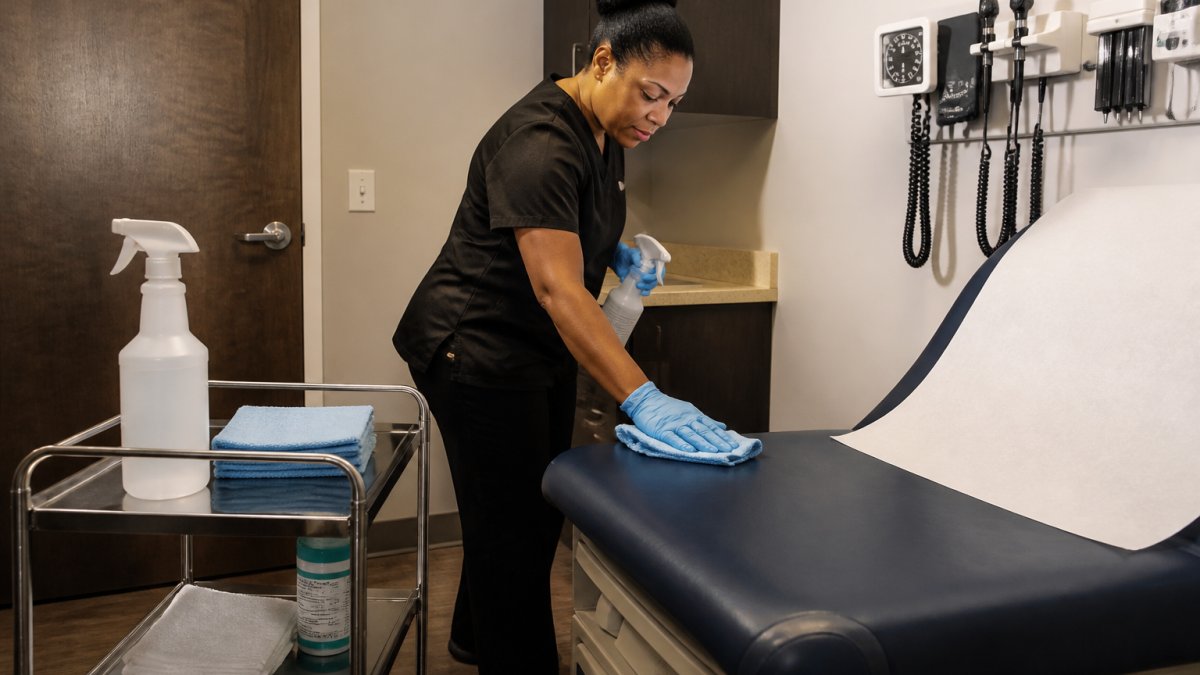
A workable structure looks like this:
- Exam and procedure rooms: Cleaned and disinfected between patients and at day's end
- Waiting areas: High-touch surfaces cleaned multiple times daily
- Restrooms: Cleaned and restocked daily at minimum
- Administrative offices: Standard cleaning on a set schedule
The Two Details That Decide Whether the Schedule Actually Works
Frequency alone does not meet infection-control standards. Two mechanisms do the real work, and both are easy to get wrong.
Contact time. Every disinfectant needs to stay wet on the surface for a specified dwell time to kill the organisms it claims to kill. If a cleaner sprays and immediately wipes dry, the product may not have had time to work.
Product selection. Not every cleaner is a disinfectant, and not every disinfectant is registered for the pathogens a clinic cares about. The EPA list of registered disinfectants for emerging viral pathogens is the reference point for products that actually meet healthcare standards.
How to Monitor Quality Instead of Assuming It
A schedule is only as good as the evidence that it was followed. Build a simple monitoring loop:
- Inspection scores: a short checklist scored on a set cadence, with a target threshold
- Missed-task rate: the percentage of scheduled tasks not completed, tracked over time
- Complaint resolution: who responds, and how fast
- Corrective-action timeline: the window for fixing a failed item and re-checking it
Documenting the schedule and the monitoring results protects your practice during inspections, gives staff a clear standard to follow, and turns "the rooms look clean" into something you can actually measure.
Medical Cleaning Contract Checklist: What to Negotiate Before You Sign
Negotiate these terms before signing any medical cleaning contract.
- Scope clarity: Exactly which rooms and surfaces are covered
- Frequency guarantees: What happens if a shift is missed
- Substitution rules: Whether the vendor can swap crews without notice
- Insurance minimums: Coverage levels and proof requirements
- Termination terms: Notice period and exit conditions
- Price adjustments: Whether rates can change mid-contract
- Quality monitoring: How performance is measured and reported
The thing nobody tells you about cleaning contracts is that vague scope language is the most common source of disputes. Define the work precisely, and both sides stay protected.
When Outsourcing Medical Cleaning Is Not Worth It
Outsourcing does not make sense for every clinic. A single-provider practice with one exam room and a small footprint may find that a part-time in-house cleaner costs less than a full contract.
It also may not be worth it if your facility has unusual security requirements that no vendor can meet, or if your cleaning needs are genuinely minimal and intermittent. In those cases, the management overhead of a contract can outweigh the benefits.
Conclusion: Making the Call for Your Practice
The decision comes down to whether your clinic can absorb the staffing, training, and compliance burden of in-house cleaning without pulling your team away from patient care. For most small and mid-sized practices, it cannot, and outsourcing wins on both cost and risk.
At Broughton Commercial Cleaning, we handle that burden for medical facilities with background-checked, licensed, insured, and bondable staff, flexible day, evening, and overnight scheduling, and upfront written quotes in plain language. If you are weighing your options, get a written quote from us and compare it against your real in-house costs, not just the hourly wage.
Frequently Asked Questions
Is it cheaper for a small clinic to outsource cleaning?
It depends on your volume and space. Outsourcing typically replaces hourly wages, benefits, training, and supply costs with one predictable service fee. For clinics under a certain square footage, in-house can be cheaper; for larger or multi-room practices, outsourcing often wins on total cost. Request a written quote based on your actual square footage and room count, then compare it against a full year of in-house staffing costs. Pricing varies by scope, so get a quote specific to your clinic.
What does medical office cleaning typically include?
Standard medical office cleaning covers exam room disinfection, waiting area surfaces, restrooms, floors, and high-touch points like door handles and light switches. It should also include proper handling of regulated medical waste, use of EPA-registered disinfectants, and documentation of cleaning frequency. Ask any vendor for a written scope that lists every room type and the products used, so you can compare quotes on equal terms.
What should a clinic look for in a medical cleaning company?
Look for experience with healthcare settings, not just general office cleaning. Verify licensing, insurance, bonding, and background-checked staff. Ask about infection-control training, EPA-registered disinfectants, and how they handle regulated waste. Request references from other medical facilities. Confirm they can work after hours or overnight so cleaning does not disrupt patient care. Finally, get a plain-language contract that spells out the scope, schedule, and what happens if a cleaning is missed.
How can a clinic verify that outsourced cleaners follow infection-control procedures?
Build verification into the contract. Require a written cleaning protocol that lists which disinfectants are used and how long they stay wet on surfaces. Ask for staff training records and check that cleaners understand the difference between cleaning and disinfecting. Schedule periodic walkthroughs with your practice administrator, and use a simple checklist to spot-check high-touch areas. If the vendor cannot show documentation, that is a red flag.
What are the disadvantages of outsourcing medical cleaning?
Outsourcing means less direct control over who enters your facility and when. You may pay more per hour than an in-house wage, and you depend on the vendor's reliability. If the contract is vague, you can end up with inconsistent crews or missed rooms. Privacy and after-hours access also require clear rules. These risks are manageable with a detailed contract, background-checked staff, and regular quality checks, but they are real and worth weighing before you sign.