 comparison
Commercial Cleaning vs Janitorial Services: Key Differences
Table of Contents
- Commercial Cleaning vs Janitorial Services: Core Differences
- What Janitorial Services Include: Daily Tasks and Routine Upkeep
- What Commercial Cleaning Services Include: Specialized and Deep Cleaning
- Commercial Cleaning Service Frequency and Scheduling
- Janitorial Cleaning Checklist: Standard Daily and Weekly Tasks
- Commercial Cleaning Cost Factors and Service Scope
- How Janitorial and Commercial Cleaning Work Together
- Choosing the Right Service for Your Facility Type
- Frequently Asked Questions
Last Updated: October 7, 2026
Commercial Cleaning vs Janitorial Services: Core Differences
Commercial cleaning janitorial services sound alike but differ fundamentally: one handles routine daily upkeep, the other specialized deep cleaning.
Think of janitorial work as daily toothbrushing and commercial cleaning as a professional dental cleaning twice a year. You need both.
Below: what each includes, how often you need them, what they cost, and how to decide which, or both, your facility needs.
What Janitorial Services Include: Daily Tasks and Routine Upkeep
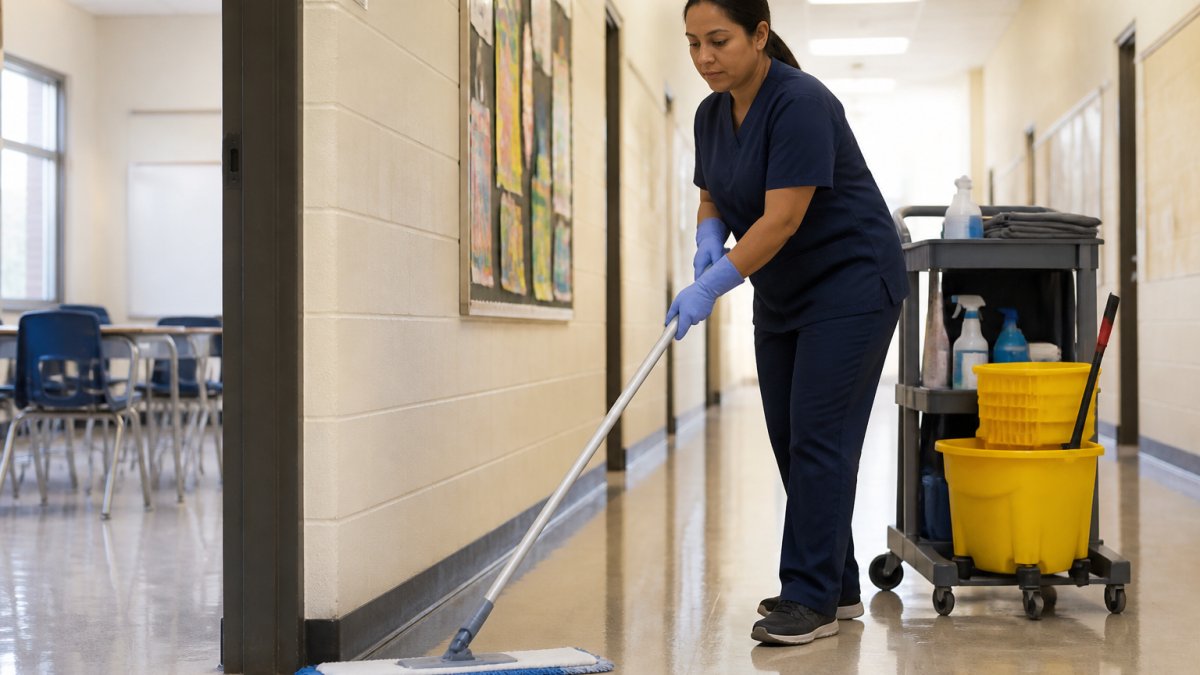
Janitorial services are the daily, repetitive tasks that prevent a space from becoming visibly dirty or unsanitary.
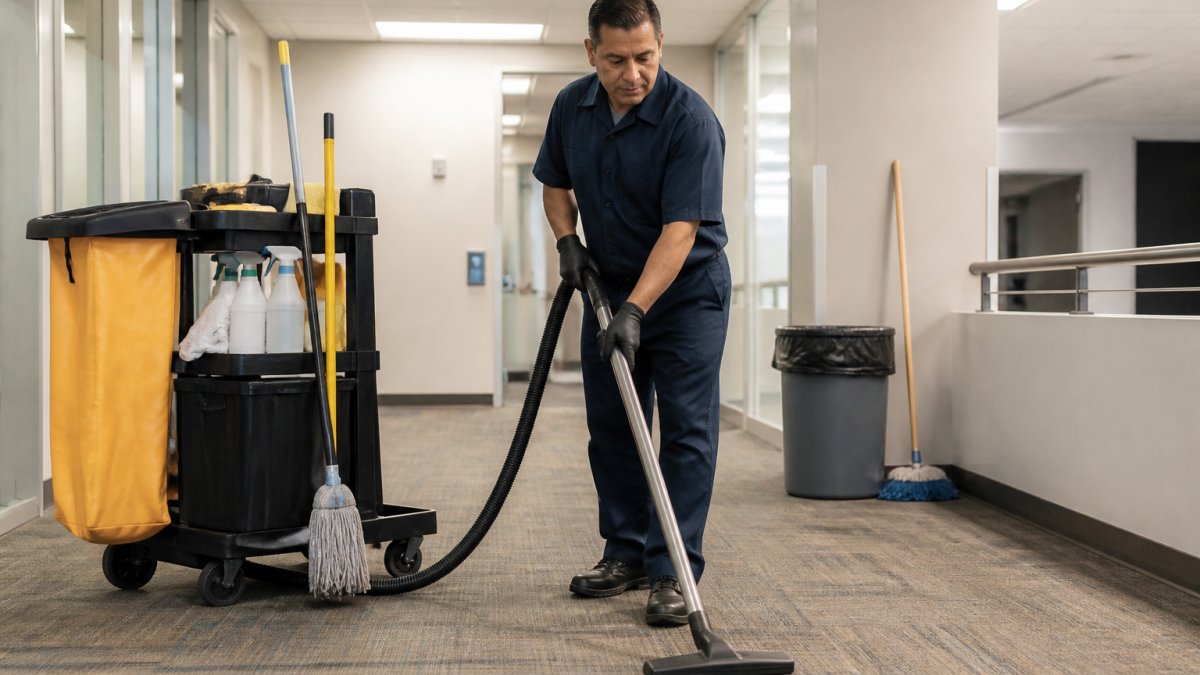
Janitorial work includes:
- Trash and waste removal: Emptying bins, replacing liners, disposing of waste properly
- Restroom cleaning and restocking: Cleaning toilets, sinks, mirrors; restocking paper towels, soap, toilet paper
- Floor maintenance: Sweeping and mopping hard floors, vacuuming carpets (surface-level, not deep cleaning)
- Dusting: Wiping down desks, tables, shelves, and other surfaces
- Surface disinfecting: Wiping high-touch surfaces like door handles, light switches, and railings
These tasks happen daily or several times weekly to maintain basic cleanliness and hygiene.
Janitorial services are essential for any occupied space, but they don't address deep-seated dirt, stains, or contaminants embedded in carpets, grout, or upholstery.
What Commercial Cleaning Services Include: Specialized and Deep Cleaning
Commercial cleaning services tackle jobs routine janitorial work can't: intensive, specialized treatments that restore surfaces and eliminate contaminants.
Commercial cleaning includes:
- Carpet extraction and deep cleaning: Using hot water extraction or steam cleaning to remove embedded dirt, allergens, and stains from carpet fibers
- Hard floor deep cleaning: Stripping, waxing, and buffing floors to restore shine and protect surfaces
- Window cleaning: Professional washing of interior and exterior windows, including frames and sills
- Grout and tile cleaning: Deep cleaning grout lines and tile surfaces, often with specialized equipment or treatments
- Upholstery cleaning: Deep cleaning chairs, couches, and fabric-covered surfaces
These services are periodic, not daily. Most facilities schedule commercial cleaning quarterly, semi-annually, or annually, depending on traffic, facility type, and contamination levels.
Commercial cleaning brings specialized equipment and trained technicians: medical facilities need hazmat-compliant protocols, warehouses need post-construction debris removal, and high-traffic offices need quarterly carpet extraction.
Commercial Cleaning Service Frequency and Scheduling
How often you need commercial cleaning depends on facility type, foot traffic, industry regulations, and your standards.
High-traffic offices benefit from quarterly carpet extraction and semi-annual hard floor deep cleaning to prevent permanent embedding and maintain appearance.
Educational facilities and community centers generally schedule commercial cleaning during breaks or quarterly, balancing budget with wear and tear.
Retail and hospitality spaces often need monthly or quarterly deep cleaning to maintain customer-facing standards, especially in entryways and restrooms.
Janitorial Cleaning Checklist: Standard Daily and Weekly Tasks
A solid janitorial program follows a consistent checklist so nothing gets missed.
Daily janitorial tasks:
- Empty all trash bins and replace liners
- Sweep and mop hard floors in common areas
- Vacuum carpeted areas (surface-level only)
- Clean and disinfect restrooms: toilets, sinks, mirrors, dispensers
- Wipe down high-touch surfaces: door handles, light switches, railings, elevator buttons
Weekly janitorial tasks:
- Dust all horizontal surfaces: desks, tables, shelves, window sills
- Clean interior windows and glass surfaces
- Disinfect common areas more thoroughly
- Deep-clean restroom grout and tile (light cleaning, not extraction)
- Vacuum under furniture and in corners
This checklist prevents dirt accumulation and keeps your facility hygienic.
Commercial Cleaning Cost Factors and Service Scope
Cost is where most comparisons get vague. Here are the pricing models you'll see, the inputs that move a quote, and how to compare scopes so a lower bid doesn't hide a smaller one.
The three pricing models you'll encounter
- Square-footage rate: A per-square-foot price applied to the cleanable area, often adjusted by frequency. Simple to compare, but it can hide scope differences because two bids at the same rate may include different task lists.
- Hourly or labor-hour rate: Price is built from estimated labor hours multiplied by an hourly rate, plus supplies and equipment. This model makes it easier to see how frequency and task count change the total.
- Flat monthly or per-visit fee: A fixed price for a defined scope and schedule. Best for budgeting, but only useful if the scope is written down and tied to a service-level agreement.
A common hybrid: a flat monthly fee for routine janitorial work plus per-service pricing for periodic commercial cleaning like carpet extraction or floor stripping.
What actually moves the quote
- Cleanable square footage vs total square footage. Storage rooms, server closets, and locked areas may be excluded. Ask which areas are in scope.
- Frequency and visit length. Daily service costs more than three visits per week, but the per-visit cost often drops as frequency rises because travel and setup are amortized.
- Task density. Restrooms per floor, kitchens, and high-touch surface counts drive labor more than raw square footage in many buildings.
- Floor types and finish requirements. Carpet, VCT, LVT, and sealed concrete each require different equipment and chemistry. Stripping and recoating cycles add labor hours that routine mopping does not.
- Specialized equipment and chemistry. Hot water extractors, floor machines, and hospital-grade disinfectants carry equipment and supply costs that show up in the quote.
How to compare two quotes fairly
Put both scopes side by side and check these line items:
- Restroom cleaning and restocking frequency
- Trash and recycling handling, including liner replacement
- Hard floor care: sweeping, mopping, and any scheduled stripping or recoating
- Carpet care: routine vacuuming versus scheduled extraction
- High-touch disinfection: which surfaces, how often, and with what product
- Window and glass cleaning: interior only or interior and exterior
If one quote is lower, find the missing or less frequent line item, that's where the difference lives.
Sample scope shapes (not prices)
Because pricing varies by market, building, and frequency, published dollar figures rarely transfer. What transfers is the shape of the scope:
- Small office, three visits per week: Routine janitorial only, with carpet extraction and hard floor restoration quoted as periodic add-ons.
- Mid-size office, five visits per week: Routine janitorial plus quarterly carpet extraction and semi-annual floor care, often bundled into an annual agreement.
- Healthcare or childcare, five to six visits per week: Routine janitorial with documented disinfection protocols, plus monthly or quarterly specialized cleaning tied to compliance requirements.
- Industrial or warehouse: Routine janitorial for offices and break areas, with periodic commercial cleaning scheduled around production shutdowns.
Broughton Commercial Cleaning provides upfront written quotes in plain language that separate routine janitorial tasks from periodic commercial cleaning janitorial tasks, so you can see exactly what each line covers before you sign.
How Janitorial and Commercial Cleaning Work Together
The best approach combines both: janitorial work keeps your facility functional day-to-day, while commercial cleaning prevents long-term damage and maintains professional standards.
Take carpet: daily vacuuming (janitorial) removes surface dirt, but over months allergens embed deep in the fibers.
For restrooms, janitorial crews handle daily cleaning and restocking, while commercial cleaning tackles grout extraction, tile restoration, and deep disinfection.
Without janitorial services, a facility looks dirty between commercial cleaning appointments; with only janitorial services, it deteriorates as dirt embeds and surfaces degrade.
Choosing the Right Service for Your Facility Type
Most comparisons stop at a facility-type list, which isn't a decision. The framework below turns the choice into four inputs you can score, then shows how to evaluate bidders.
Step 1: Score the four inputs
Rate each input on a 1-5 scale. The total points toward whether you need janitorial only, commercial cleaning only, or both.
- Building size (square footage). Under 5,000 sq ft, a single crew can usually absorb both routine and periodic work. Above 25,000 sq ft, the labor hours required for daily upkeep typically force a dedicated janitorial contract separate from periodic deep cleaning.
- Occupancy and foot traffic. Count peak occupants and daily visitors. High-traffic entries, lobbies, and restrooms drive restroom restocking and floor care frequency more than total square footage does.
- Operating hours. Single-shift operations allow after-hours cleaning. Multi-shift or 24-hour operations often require day porters for restrooms and trash, with deep cleaning scheduled during shutdown windows.
- Risk level. Healthcare, childcare, food service, and labs carry infection-control or sanitation requirements that push disinfection protocols and documentation into the janitorial scope itself, not just periodic cleaning.
Step 2: Map the score to a service model
- Low size, low traffic, low risk (roughly 4-8 points): Janitorial only, two to three visits per week, with commercial cleaning scheduled as needed for carpet and hard floor restoration.
- Mid size, mid traffic, mid risk (roughly 9-14 points): Combined program. Daily or five-day janitorial plus quarterly commercial deep cleaning.
- High size, high traffic, high risk (roughly 15-20 points): Combined program with day-porter coverage, documented disinfection protocols, and monthly or quarterly specialized cleaning depending on the regulatory driver.
Step 3: Build the scope around priorities, not categories
List your top three cleaning priorities in order. Common examples:
- Restroom appearance and restocking during business hours
- Carpet appearance in client-facing areas
- Floor finish durability in entryways and corridors
- Disinfection documentation for compliance audits
Assign each priority to the service model that controls it. Restroom restocking is janitorial. Carpet appearance in a high-traffic lobby is usually commercial cleaning, since embedded soil returns faster than routine vacuuming can manage. Floor finish durability is commercial cleaning, depending on stripping and recoating cycles, not daily mopping.
Step 4: Evaluate providers with a checklist
Before signing, ask every bidder the same questions and compare answers side by side.
- Insurance and bonding: General liability and workers' compensation coverage, with certificates provided before the first shift.
- Training: Onboarding for new hires, ongoing training on chemical dilution and equipment use, and documented safety training.
- Background checks: Whether all staff assigned to your facility are screened, and how substitutions are handled.
- Quality control: Inspection frequency, who performs inspections, and how findings are reported to you.
- Supplies and equipment: Whether consumables are included in the price or billed separately, and who supplies specialty equipment like extractors and floor machines.
- Escalation: Who you call for a missed task, a spill, or an after-hours issue, and the expected response window.
Step 5: Put measurable outcomes in the agreement
A service-level agreement turns the scope into something you can verify. Useful metrics include:
- Inspection score: A defined checklist scored on a set cadence, with a target pass rate.
- Response time: The window for responding to a call or work order, measured from notification to acknowledgment.
- Task completion rate: Percentage of scheduled tasks completed on the scheduled visit.
- Complaint resolution: Time from complaint to resolution, tracked per month.
Frequently Asked Questions
What is the difference between commercial cleaning and janitorial services?
Janitorial services focus on routine, daily upkeep such as vacuuming, trash removal, restroom restocking, and surface dusting. Commercial cleaning encompasses specialized, periodic deep cleaning tasks like carpet extraction, window washing, floor stripping, and sanitizing high-touch surfaces. Janitorial work keeps a facility maintained; commercial cleaning handles intensive treatments. Most businesses use both services to maintain a clean, hazard-free environment year-round.
How often should a business schedule janitorial services versus commercial cleaning?
Janitorial services typically run daily or multiple times per week, depending on facility type and occupancy. A busy office may need daily restroom cleaning and trash removal, while a light-use warehouse might need twice-weekly vacuuming and dusting. Commercial cleaning services are scheduled less frequently, quarterly, semi-annually, or annually, based on facility needs, traffic, and wear. A janitorial cleaning checklist covers routine maintenance; commercial cleaning addresses accumulated buildup and specialized care.
What factors affect commercial cleaning cost?
Commercial cleaning cost factors include square footage, facility type, service scope, cleaning frequency, equipment requirements, and specialized protocols. Medical facilities with infection control needs cost more than standard offices. Post-construction cleanup requires heavy-duty equipment and trained crews. Pricing also reflects labor costs, staff certifications, insurance, and bonding. Request a written quote that details scope and service frequency to understand what drives your facility's pricing.
Can one cleaning company handle both janitorial and commercial cleaning services?
Yes. Many professional cleaning companies offer both routine janitorial maintenance and specialized commercial cleaning services. This integrated approach ensures consistent quality, familiar staff, and simplified scheduling. A single vendor can manage your daily upkeep while scheduling deep cleaning treatments on a regular cycle. This coordination helps maintain facility hygiene standards and reduces the complexity of managing multiple service providers.