 comparison
Medical Facility Sanitation vs Standard Office Cleaning
Table of Contents
- Medical Facility Sanitation vs Standard Office Cleaning: How They Differ
- Side-by-Side: Medical Sanitation Compared to Standard Office Cleaning
- Medical Office Disinfection Procedures and the Correct Cleaning Sequence
- Medical Office Cleaning Frequency: How Often Each Zone Needs Attention
- Medical Office Cleaning Checklist: What Belongs in Every Protocol
- Medical Cleaning Staff Training, PPE, and Worker Safety
- Quality Assurance and What Drives the Cost of Medical Facility Sanitation
- Choosing a Medical Cleaning Provider: Questions to Ask Before You Sign
- Frequently Asked Questions
Last Updated: October 9, 2026
Medical Facility Sanitation vs Standard Office Cleaning: How They Differ
Medical facility sanitation is the practice of cleaning and disinfecting clinical spaces to reduce disease transmission, not just to make them look presentable.
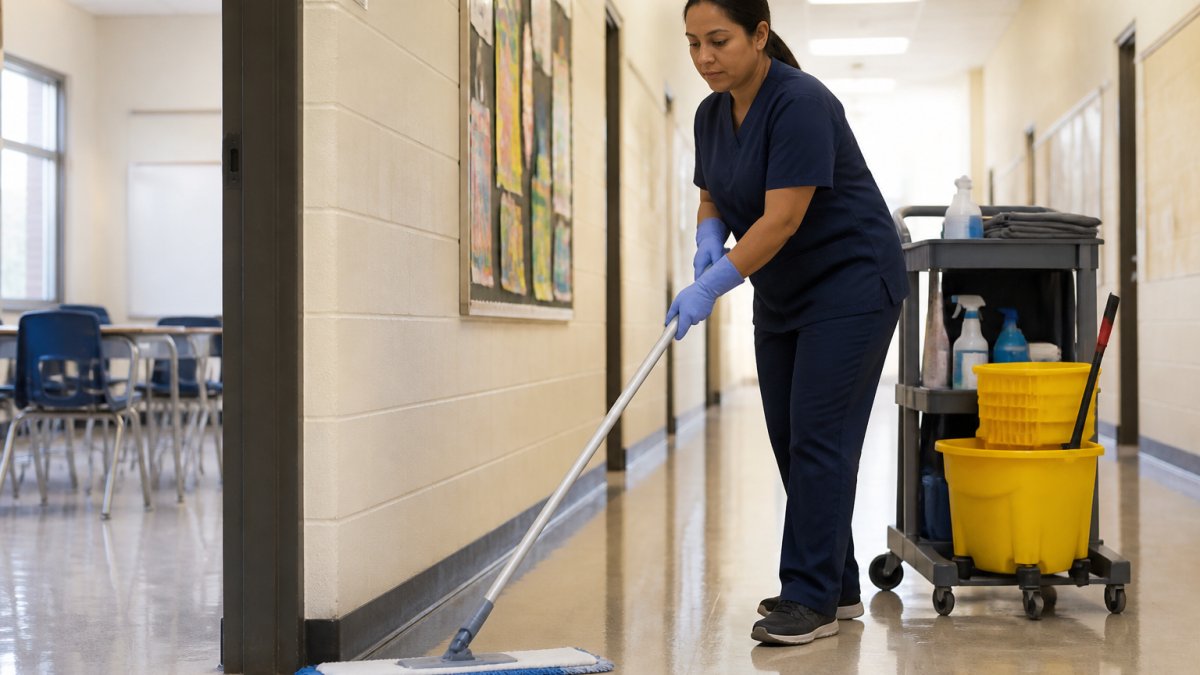
The difference comes down to purpose. Standard office cleaning removes dust, debris, and visible soil to protect appearance and indoor air quality. Medical cleaning adds a second job: reducing bio-load on high-touch surfaces.
A missed high-touch surface in a standard office is an eyesore; in an exam room, it is a potential infection control failure.
CDC guidance on environmental cleaning in healthcare settings frames surface cleaning as a core infection prevention measure, not a cosmetic task.
Cleaning, Sanitizing, and Disinfecting: Three Different Jobs
These three terms get used interchangeably in most cleaning contracts. They should not be.
Cleaning is the physical removal of dust, debris, and organic soil, the necessary first step.
Sanitizing reduces germs to a level considered safe by public health standards, but does not eliminate pathogens.
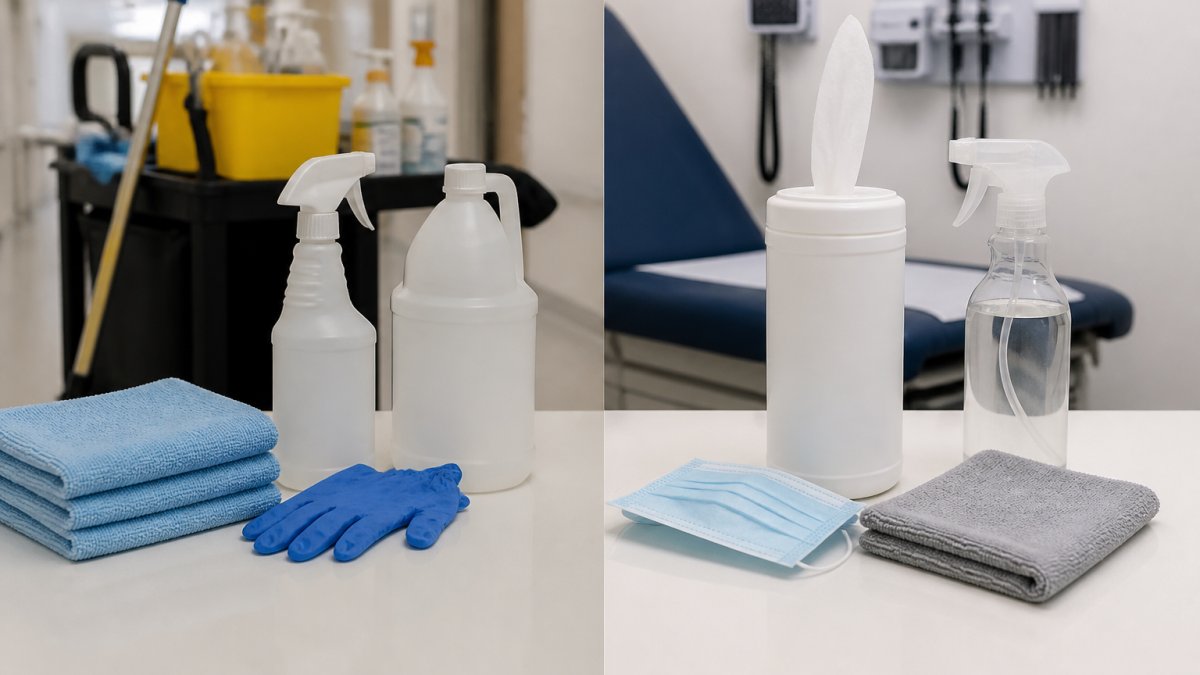
Disinfecting kills or inactivates pathogens after cleaning, the step that matters most clinically.
The order is fixed: clean first, then sanitize or disinfect.
Side-by-Side: Medical Sanitation Compared to Standard Office Cleaning
Medical sanitation and standard office cleaning differ on purpose, products, sequence, frequency, training, and documentation. The table below summarizes where they diverge.
| Factor | Standard Office Cleaning | Medical Facility Sanitation |
|---|---|---|
| Primary goal | Appearance and indoor air quality | Infection prevention and control |
| Products used | General-purpose cleaners and glass cleaner | EPA-registered hospital-grade disinfectants, matched to the surface and pathogen of concern |
| Application method | Spray and wipe; contact time rarely specified | Clean first, then apply disinfectant per label; contact time followed to the second |
| Sequence | Room by room, top to bottom | Clean-to-dirty path, high-touch first, terminal clean at end of day |
| Frequency | Usually nightly or weekly | Zone-based, from between-patient resets to weekly detail work |
| Staff training | General janitorial orientation | Bloodborne pathogen, PPE, regulated medical waste, and sharps training |
| Documentation | Minimal or none | Zone checklists, disinfection logs, inspection records |
| Waste handling | Standard municipal trash and recycling | Segregated regulated medical waste, sharps containers, and pharmaceutical waste where applicable |
| Oversight | Supervisor spot checks | Documented QA inspections with corrective action tracking |
Why the product line is the clearest dividing line
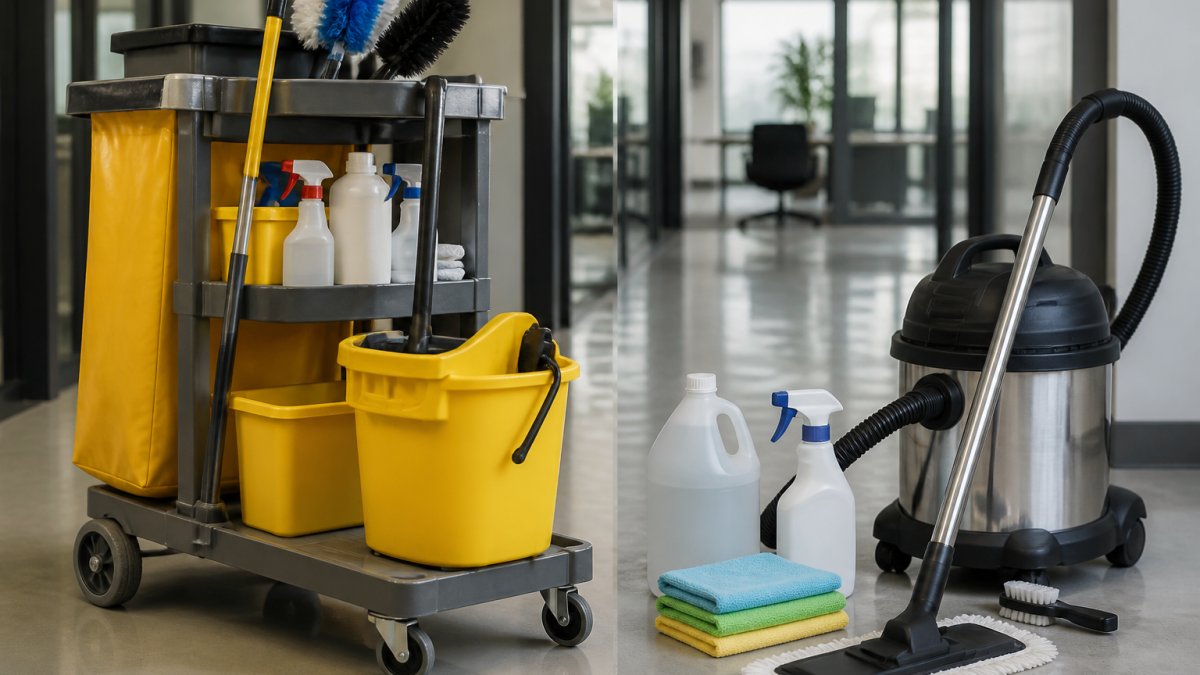
Standard office cleaning relies on general cleaners that lift soil and leave a fresh scent. Medical cleaning requires EPA-registered disinfectants applied at the label's dilution and contact time. A general cleaner carries no kill claim against pathogens like C. difficile, MRSA, or norovirus. A hospital-grade disinfectant does, but only when the surface is pre-cleaned and stays wet for the full label contact time, often one to ten minutes.
Why frequency is the second divide
A standard office can run on a nightly sweep with weekly detail work. A medical office cannot. Exam rooms, restrooms, and shared equipment need attention tied to patient volume and risk, not to how the space looks at 6 p.m. A conference room wiped once a day and an exam room reset between every patient are not the same job, even at identical square footage.
How the same building can need both services
Most medical facilities are not uniformly clinical. A single practice may contain:
- Reception and waiting areas, high-touch but lower-risk; frequent wipe-downs of seating, door handles, and check-in counters.
- Exam and treatment rooms, between-patient disinfection of tables, chairs, and shared equipment, plus a terminal clean at end of day.
- Restrooms, at least daily, often more, with attention to fixtures, dispensers, and floors using a clean-to-dirty workflow.
Treating the whole building as one uniform environment either over-cleans the file room or under-cleans the exam room. The right answer is a zone map assigning each area its own product, frequency, and documentation.
Medical Office Disinfection Procedures and the Correct Cleaning Sequence
Medical office disinfection procedures follow a strict sequence: clean the surface, apply the disinfectant, allow full contact time, then move on.
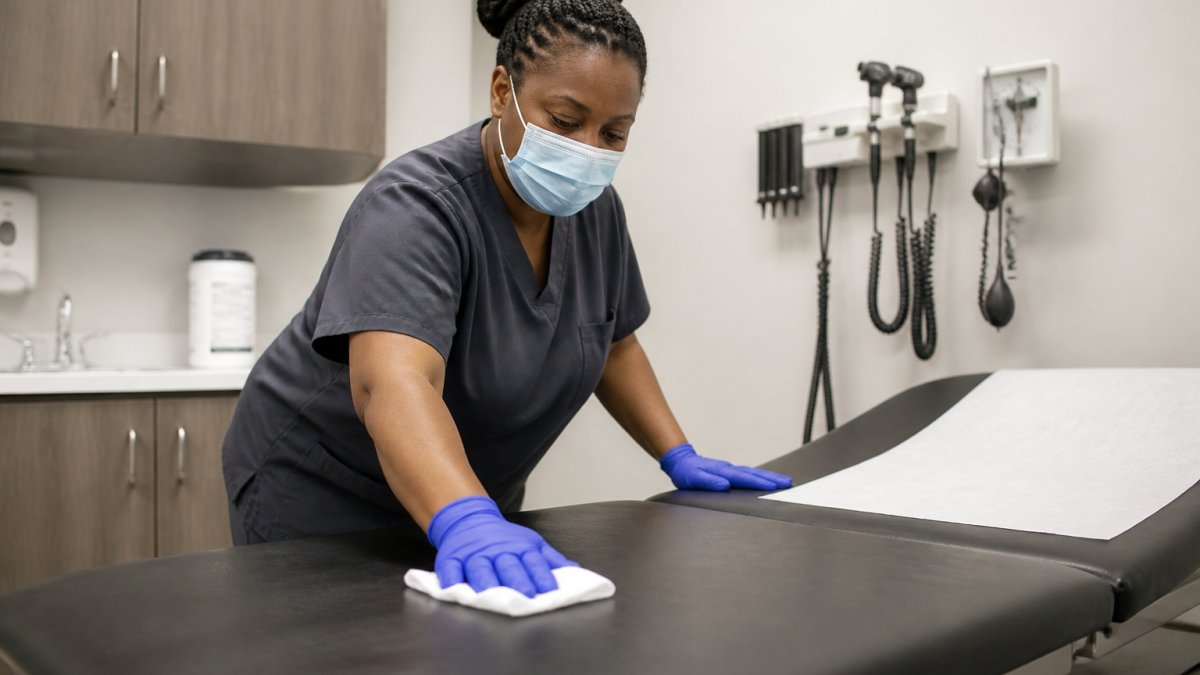
Contact time is where most protocols quietly fail. Every EPA-registered disinfectant lists a dwell time, often one to ten minutes.
A common mistake is spraying a cloth instead of the surface. Label directions govern application, and deviating voids the disinfection claim.
EPA information on registered disinfectant products and contact time is the reference point for verifying that a product is registered and used correctly.
Medical Office Cleaning Frequency: How Often Each Zone Needs Attention
Medical office cleaning frequency is not one schedule but a set of schedules, assigned by zone and risk level.
High-touch surfaces in patient areas, exam tables, door handles, shared equipment, typically need disinfection between patients or several times daily.
The logic is risk-based. The more a surface is touched and the more vulnerable the people touching it, the more often it needs disinfection.
How often should exam rooms be cleaned?
Exam rooms should be cleaned and disinfected between patient visits, with a full terminal clean at day's end. Shared equipment needs disinfection between each use, per the manufacturer's and the disinfectant label's directions.
That schedule is the clearest practical difference between medical facility sanitation vs standard office cleaning. A conference room might get wiped once a day; an exam room gets reset after every patient.
Medical Office Cleaning Checklist: What Belongs in Every Protocol
A medical office cleaning checklist turns an infection control policy into daily, verifiable work. Without one, cleaning quality depends on who is on shift.
Every medical cleaning checklist should cover these areas:
- High-touch surfaces: door handles, light switches, railings, elevator buttons
- Exam tables and patient chairs, disinfected between patients
- Shared equipment: blood pressure cuffs, otoscopes, keyboards, tablets
The checklist should name the product, contact time, and zone for each task. Vague instructions like "disinfect surfaces" leave too much to interpretation.
Medical Cleaning Staff Training, PPE, and Worker Safety
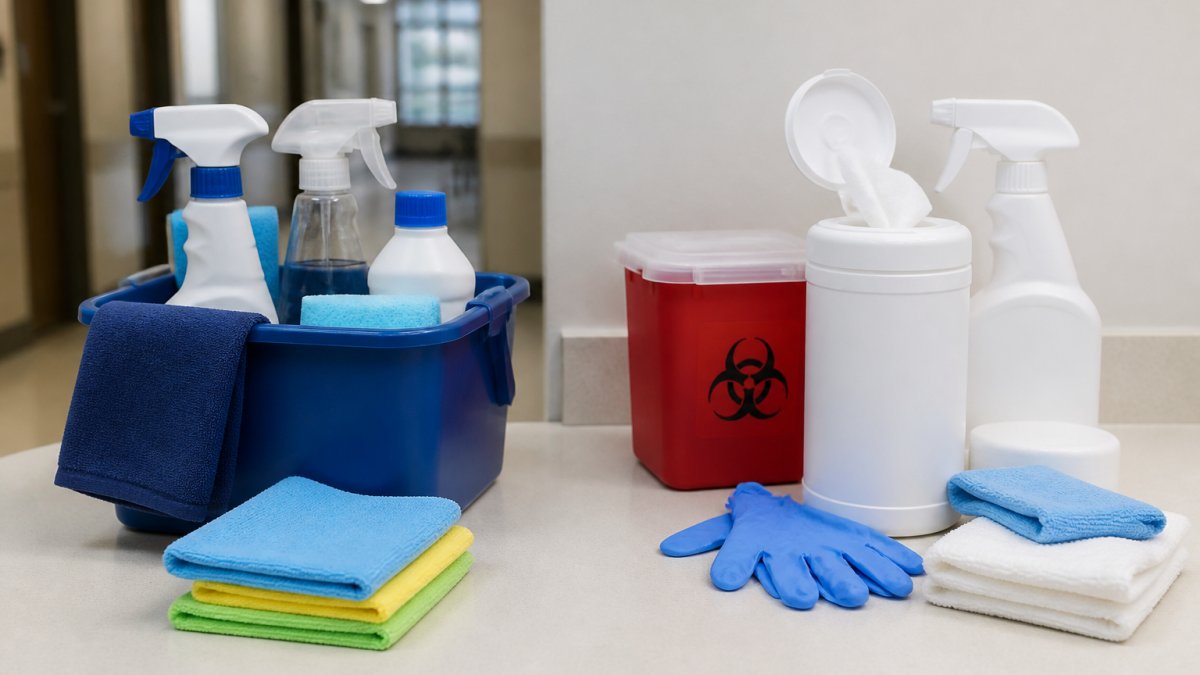
Medical cleaning staff training covers hazards standard janitorial work does not: bloodborne pathogen awareness, regulated medical waste handling, sharps disposal, and correct PPE use.
The training requirement is not optional. OSHA bloodborne pathogens standard for occupational exposure sets the expectations for worker protection in settings where blood and other potentially infectious materials may be present.
PPE is the second layer. Gloves, eye protection, and gowns or aprons are standard for disinfection work in clinical spaces.
Worker safety and patient safety are the same conversation. A technician who cannot remove gloves without touching the outside is a cross-contamination risk in every room they enter.
Quality Assurance and What Drives the Cost of Medical Facility Sanitation
Quality assurance in medical cleaning means inspection, documentation, and correction, not a verbal promise that the work was done. Without it, a facility cannot know whether its infection control protocol is actually followed. This is the area most cleaning contracts leave vague.
Measurable quality indicators
A workable QA program uses indicators that can be counted, scored, and trended:
- Zone inspection scores, a standard scoring sheet (for example, a 0-5 scale per surface) completed on a set cadence, with a target pass threshold.
- High-touch surface coverage rate, the percentage of listed high-touch surfaces verified as cleaned during an inspection.
- Disinfection log completeness, the share of required logs that are signed, dated, and free of gaps.
- Contact-time compliance, spot checks confirming the product stayed wet for the full label dwell time.
- Corrective action closure rate, the percentage of identified misses fixed within an agreed window, such as 24 or 48 hours.
- Re-inspection pass rate, whether a corrected zone stays corrected on the next audit.
Audit cadence that actually catches problems
A practical pattern is:
- Daily, technician self-check against the zone checklist before leaving the area.
- Weekly, supervisor inspection of a rotating sample of zones, scored on the standard sheet.
- Monthly, full-facility review with the practice administrator, including trend data and open corrective actions.
A single annual walkthrough will not catch a contact-time shortcut happening every night for six months. Cadence is what makes QA real.
Verification methods
Visual inspection catches soil and missed surfaces but does not confirm disinfection. Two common supplements:
- ATP swabs, a handheld meter that reads organic residue left on a surface, giving a pass/fail signal within seconds. Useful for trending, not for regulatory claims.
- Fluorescent marking, a UV-visible gel applied before cleaning and checked after, used to verify that a specific surface was touched at all.
Neither replaces a documented protocol, but both give evidence that it is being executed.
What drives the cost of medical facility sanitation
Medical facility sanitation costs more than standard office cleaning because it takes longer per square foot, uses pricier EPA-registered products, and requires trained, background-checked staff. The drivers:
- Frequency and risk level, a between-patient reset schedule costs far more than a nightly sweep, and it is the single biggest lever on the estimate.
- Zone mix, the ratio of clinical to administrative square footage determines how much of the building needs the full protocol.
- Product and dilution, hospital-grade disinfectants and correct dilution equipment cost more than general cleaners, and mis-dilution wastes both product and labor.
Square footage matters but is rarely the deciding factor. Two 3,000-square-foot practices with the same floor plan can get very different quotes if one runs a between-patient reset and the other does not.
How to read a medical cleaning quote
A quote you can actually compare should state, at minimum:
- The zones covered and the frequency for each
- The products to be used, with EPA registration numbers
- The contact time assumed for each product
If a quote lists a single per-square-foot number with no zone breakdown, you cannot tell whether exam rooms are reset between patients or just wiped at night. Ask for the breakdown before signing.
Choosing a Medical Cleaning Provider: Questions to Ask Before You Sign
Choosing a medical cleaning provider comes down to one question: can they prove they understand clinical cleaning, or are they a standard office cleaner in a medical building?
Ask these before you sign:
- What disinfectants do you use, and are they EPA-registered for healthcare? A vague answer here is a red flag.
- How do you handle contact time and label directions? The answer should reference specific products and dwell times.
- What training does your staff complete, and how is it documented? Look for bloodborne pathogen and PPE training records.
- How do you handle regulated medical waste and sharps? They should describe a defined, compliant process.
- What does your quality assurance look like? Ask to see a sample inspection sheet and a cleaning log.
- Are your staff background-checked, licensed, insured, and bondable? This protects both patient privacy and your practice.
- Can you cover our schedule, including overnight or early morning shifts? A 24/7 operation needs a vendor with real staffing depth.
- Is your quote in plain language, with no hidden fees? What you are quoted should be what you pay.
Medical facility sanitation and standard office cleaning are not the same service with a different label. One protects appearance; the other protects patients, staff, and your compliance standing.
Running a medical practice means you cannot afford a cleaning vendor that treats your exam rooms like a standard office.
Frequently Asked Questions
What is the difference between medical facility cleaning and standard office cleaning?
Medical facility sanitation targets infection prevention, not just appearance. Standard office cleaning removes dust and debris from desks, floors, and break rooms. Medical cleaning adds EPA-registered disinfectants, strict dwell times, clean-to-dirty workflows, and documented protocols for exam rooms, patient areas, and shared equipment. The goal shifts from looking clean to reducing pathogens that cause healthcare-associated infections.
How often should a medical facility be cleaned and disinfected?
High-touch surfaces like door handles, exam tables, and waiting room chairs need disinfection at least daily, and often between patients. Patient rooms and exam rooms are typically cleaned and disinfected daily or after each use. Restrooms and waiting rooms generally receive daily or twice-daily service. A risk-based schedule that matches medical office cleaning frequency to room use and bio-load is more effective than a fixed weekly routine.
Does medical office cleaning require specialized training?
Yes. Medical cleaning staff training covers disinfectant selection, correct dilution, contact time, PPE use, regulated medical waste handling, and OSHA requirements such as the Bloodborne Pathogens standard. Staff also learn clean-to-dirty sequencing to prevent cross-contamination. Standard janitorial training does not cover these procedures, which is why a general office cleaner is rarely qualified for clinical spaces.
Can a standard janitorial service clean a medical office?
A standard janitorial service can handle non-clinical areas like lobbies and administrative offices, but clinical spaces require healthcare-specific protocols. If a vendor cannot show EPA-registered disinfectants, documented medical office disinfection procedures, trained staff, and quality assurance inspections, they should not clean exam rooms, patient areas, or handle sharps and regulated medical waste.